Author: dam

  • River Swimming Near You: Check Access, Quality and Flow

    River Swimming Near You: Check Access, Quality and Flow

    A river swimming spot needs legal access, permission to swim and separate checks of water quality and river conditions. A map pin, public footpath or bathing-water classification does not establish whether you should get in today.

    Start with the exact river entry: swimming must be permitted, access must be open for your visit, and any admission fee, parking charge or advance booking must be checked. A seasonal gate, closed path or swimming ban can rule out a place even when the river itself is publicly accessible.

    The useful search is not simply for the nearest river. It is for a permitted entry with a workable exit, relevant official water-quality information and conditions you can assess. A pin on a map is not permission to swim.

    Category: Near you. This is a planning guide, not a live list of open swimming spots. It provides no individual-site opening notice or dated water-quality result; those checks need to be made for your chosen entry before each visit.

    Find the river entry, not just the river

    Maps help locate candidates, but the important detail is the route between the public road and the water. A riverbank may be public while the shortest path to it crosses a private drive, railway land or a restricted section of a park.

    1. Search around a named place. Combine your town, county, state or postcode with terms such as “river swimming” or “public river swimming area”. Search around the park entrance or access point, rather than relying on the river’s map label.
    2. Identify the land manager. Find the park, council, recreation-area operator or landowner responsible for that bank. In the United States, this may be a municipal or county parks department, state park, National Park Service, U.S. Forest Service or Bureau of Land Management office.
    3. Trace the complete route. Establish the parking location, entrance, public path, gates and final approach to the water. Note the walk distance, surface and any steps or steep banks, especially when travelling with children or someone with limited mobility.
    4. Locate an exit before committing to the trip. The intended exit must also be accessible and permitted. Do not plan around scrambling onto a private bank or crossing a stronger channel to get out.

    Google Maps, Apple Maps, OpenStreetMap, trail apps and swimming directories can help with discovery. Visitor photographs and reviews cannot establish permission, current opening status or water quality.

    Check permission, opening status and costs separately

    Legal access to land and permission to swim are different checks. A public footpath may allow passage beside a river without granting access down the bank. Public ownership of a park does not remove swimming restrictions within it.

    Location Access rule to check
    United States Use the responsible land manager’s rules for the exact reach. National Park Service land remains subject to park closures, swimming restrictions and designated-use rules.
    England The Countryside and Rights of Way Act 2000 does not create a general right to swim in rivers. Establish permission for the entry and the route through the landowner, operator or local access authority.
    Wales Check the specific path, riverbank and swimming permission with the landowner or responsible authority. Follow local restrictions; countryside access is not blanket permission to enter any river.
    Scotland The Land Reform (Scotland) Act 2003 provides responsible non-motorised access to most land and inland water, subject to exclusions and restrictions. Follow the Scottish Outdoor Access Code.

    For your chosen entry, record open only when both the approach and water entry are permitted for your visit. Record seasonal where access depends on defined opening dates, and write down those dates. Keep lifeguard hours separate: an accessible bank is not necessarily supervised.
    Rabeebur Rahman / Pexels

    Book ahead applies where entry, parking or a permit requires a reservation. Check admission and parking charges separately, including the currency and any gate-closing time. Do not describe a spot as free simply because the path has no ticket booth.

    A closure, swimming ban or official instruction to avoid the water takes priority over an older listing. An informal path around a barrier is not an alternative entrance.

    Read the official water-quality information correctly

    Look for information about the same swimming reach, not just the same river. A monitoring point upstream of a sewage outfall, tributary or town may not describe conditions at your entry.

    Region Official information to check Coverage limit
    United States State, county, municipal or park-agency recreational-water results and health advisories. The EPA beach programme covers coastal and Great Lakes recreational beaches, not every inland river. Inland monitoring varies locally.
    England Environment Agency Swimfo profiles, classifications, sample information and pollution-risk advice for designated bathing waters. Most informal river entries are not designated bathing waters and do not receive routine statutory bathing-water classification.
    Wales Natural Resources Wales designated bathing-water information and pollution-risk advice. An undesignated river entry may have no comparable routine bathing-water classification.
    Scotland Scottish Environment Protection Agency bathing-water information and pollution-risk forecasts for designated sites. A nearby designated site does not automatically cover an informal river entry.

    In England, the annual classifications are Excellent, Good, Sufficient and Poor. They describe microbiological quality using samples collected during bathing seasons. They are not a same-day clearance, and designation does not mean lifeguards are present.

    For a published sample, record the agency, monitoring location, sample date, parameter, result and units, together with the agency’s advisory threshold or interpretation. Also check for a newer warning. The date a page was updated is not necessarily the date the water was sampled.
    Siarhei Nester / Pexels
    • No dated result at the entry: write “No official dated water-quality result found for this entry”, followed by the date you checked. Missing data does not mean clean water.
    • A result from another reach: identify that limitation rather than transferring its rating to your entry.
    • An older favourable result: check for subsequent rain, sewage incidents and health advisories. A laboratory sample describes a particular place and time.
    • Clear-looking water: do not treat visibility, colour or popularity as evidence of microbiological quality.

    Water-quality information also does not assess current strength, cold shock, submerged obstacles or the difficulty of getting out. Those need a separate check.

    Check upstream rain, river levels and flow

    Dry weather at the riverbank does not rule out rising water. Rain elsewhere in the catchment can arrive later, bringing stronger flow, debris and pollution. Check upstream conditions as well as the forecast at your destination.

    1. Read flood and weather warnings. In the United States, use National Weather Service warnings alongside local park alerts. In the UK, check the relevant official flood-warning and river-level service.
    2. Choose a relevant gauge. The USGS National Water Dashboard provides streamflow and gauge-height information for U.S. monitoring stations. Environment Agency river-level information serves monitored locations in England. Match the station to your reach and catchment, not simply the shortest map distance.
    3. Read the timestamp and trend. A rising level means conditions are changing. A falling level does not make a river suitable for swimming if flow remains high, debris is moving or pollution advice remains in force.
    4. Check local rainfall and pollution advice. Follow the authority’s warning period for that site. Do not substitute a blanket 24-, 48- or 72-hour waiting rule.

    Discharge is usually reported in cubic feet per second in the United States and cubic metres per second in the UK. It measures the volume passing a point, not the current speed at your entry. There is no universal discharge or water-depth threshold that makes every river suitable for swimming.

    Heavy rain is both a flow warning and a pollution warning. It can wash livestock waste and road runoff into rivers and trigger discharges from combined sewer systems. Water levels and bacterial contamination do not necessarily recover on the same timetable.

    Inspect the entry, exit and downstream hazards

    Once there, assess the reach from the bank before changing or entering. A calm-looking pool may drain directly towards a weir, culvert or fallen tree. Being a strong pool swimmer does not remove those hazards.
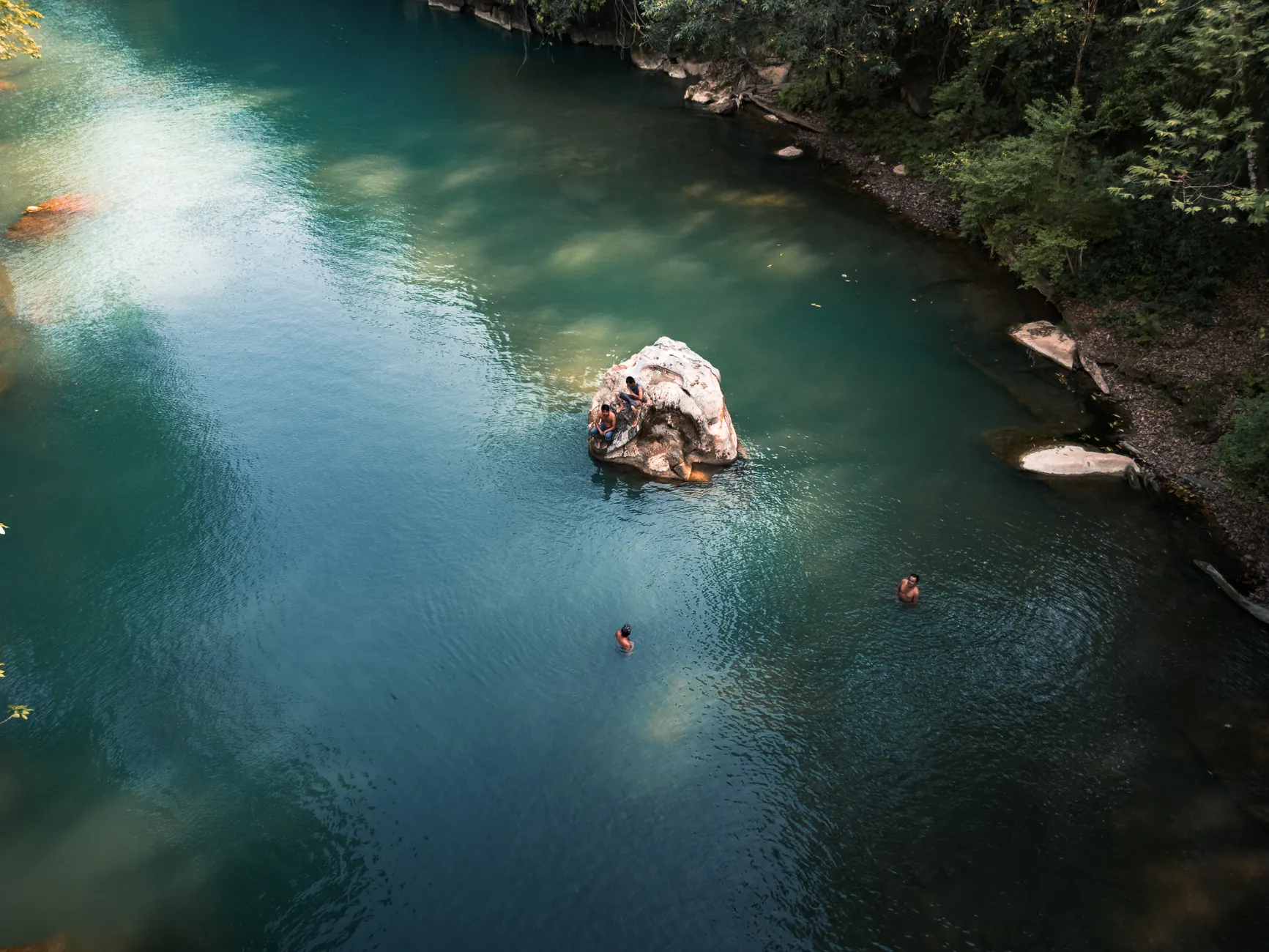
    Miguel González / Pexels
    1. Read the latest signs. Check the entrance and water’s edge for closures, pollution warnings, release notices and no-swimming rules.
    2. Watch the water for several minutes. Leave if it is rising, carrying branches, becoming discoloured or changing visibly. Unexpected foam, visible algal scum or an official cyanobacteria warning is a reason to stay out.
    3. Inspect your exit from land. Choose stable footing that does not depend on climbing a muddy vertical bank. Identify a permitted downstream backup exit without planning a swim that relies on drifting to it.
    4. Check where the current leads. Stay out where it carries towards fallen trees, fencing, bridge openings, culverts or other obstructions. Avoid weirs and low-head dams, including apparently smooth water above them.
    5. Enter slowly, feet first, only if the checks support entering. Do not jump or dive into unfamiliar water. If the current makes standing or reaching the exit uncertain, do not continue.

    Outside bends, narrow channels and gaps between rocks can concentrate flow. Eroded, undercut banks may conceal cavities. Fallen trees and fences can act as strainers: water passes through while a swimmer becomes trapped. Walking in moving water also brings foot-entrapment risk, where a foot wedges between rocks and the current pushes the body downstream.

    Warm air does not mean warm water. Groundwater, snowmelt, shade and reservoir releases can keep rivers cold in summer. Gradual entry helps you respond to the temperature; if breathing becomes uncontrolled, get out rather than pushing on.

    Resolve missing information without guessing

    • The map shows an entry but the route reaches private land: use the manager’s published public entrance. If no authorised route is available, choose another site rather than following a worn path.
    • The park is open but swimming rules are missing: establish the rule for that reach with the operator before travelling. General park access is not enough.
    • The nearest gauge is on another tributary or beyond a major confluence: look for a better-matched station or local advice. Do not translate the reading into a swimming decision for a different channel.
    • No official water-quality result is available: consider a managed or designated site with relevant monitoring instead. Appearance and visitor reviews cannot fill the data gap.
    • The exit is blocked or conditions differ from the description: abandon the swim. An improvised crossing or downstream drift is not a substitute for a planned exit.

    Prepare for cold water and an emergency

    Use a competent companion and tell someone on land the river name, exact entry, planned exit and expected return. Carry a reliable way to raise the alarm, and save the access details before leaving mobile coverage.

    • Visibility and flotation: bright swimwear and a tow float can help others see you. A tow float is not a lifejacket. A properly fitted buoyancy aid does not make strong current or a weir suitable for swimming.
    • Children: keep them within reach around moving water. Shallow margins can contain abrupt holes or stronger current a step away.
    • Health: cover cuts, avoid swallowing river water and wash afterwards. Seek medical advice if you become ill after freshwater exposure, and mention the swim.
    • Impairment: do not swim after drinking alcohol or using drugs.
    • Rescue: call 911 in the United States or 999 in the UK. Give the river name, access point, nearby landmark and downstream direction. Do not enter the current to rescue someone; use a reach-or-throw aid from a secure position where possible.

    Keep a dated record for your chosen spot

    Save the access permission, opening status, fees and booking details with the responsible authority’s name and the date checked. Record water-quality sample dates separately from the date you viewed them, and retain the relevant gauge timestamp and warning information. These details can change independently.

    Choose the entry, not just the river: permitted access, an open route, relevant official water-quality information and a usable exit all matter. Swimming outdoors is at your own risk; check current closures, pollution advice, upstream weather and river conditions again before getting in.
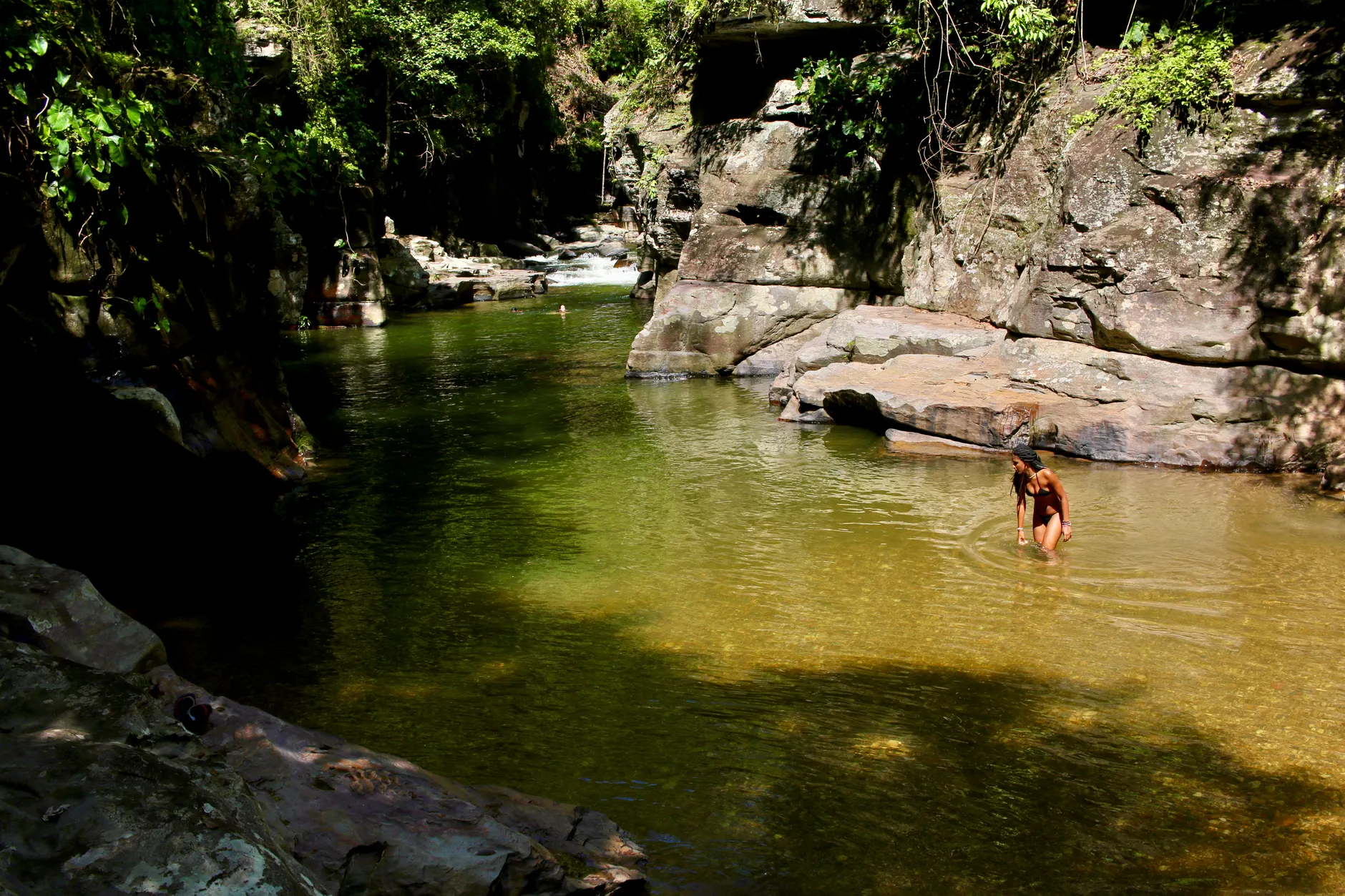
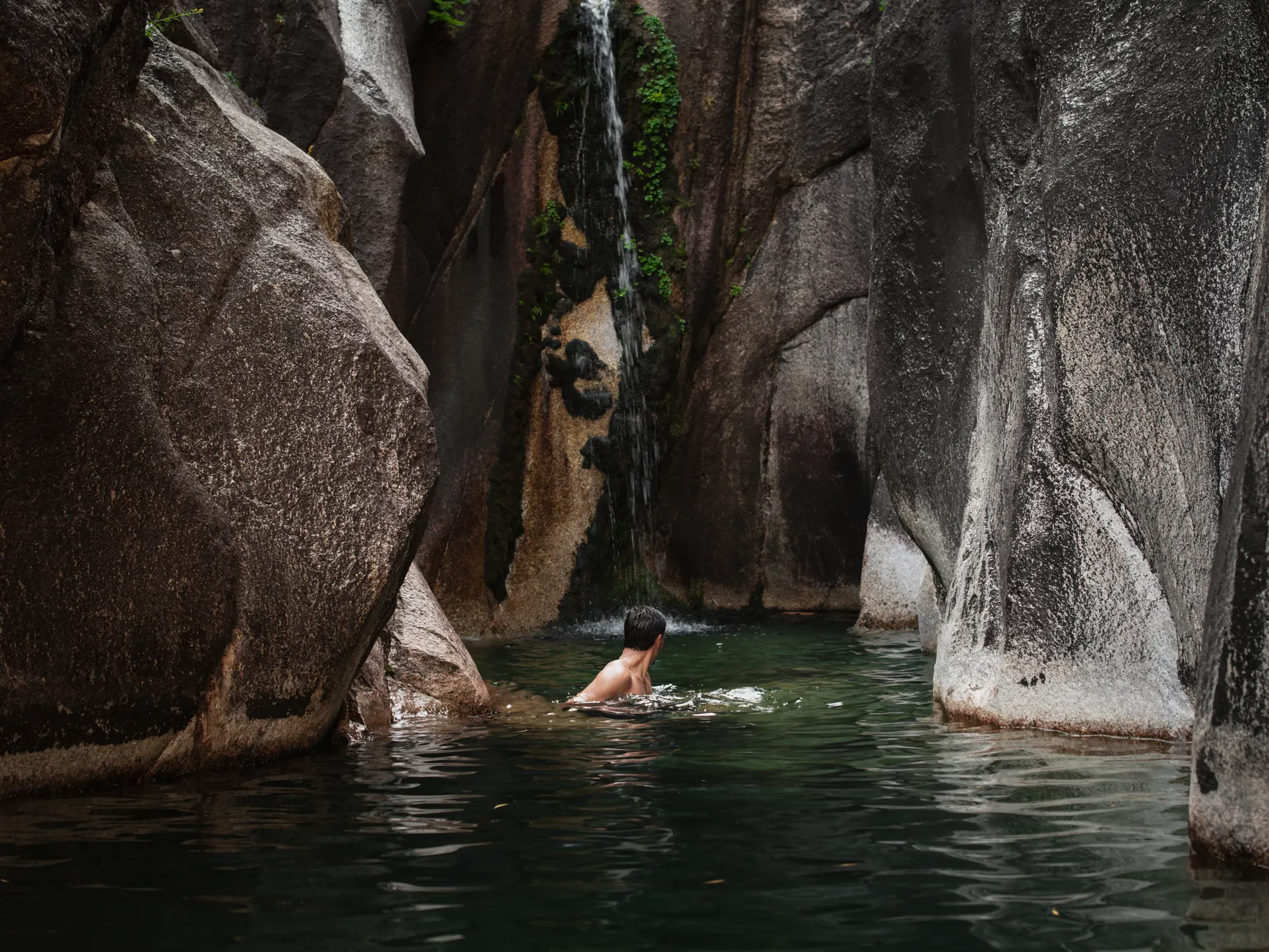
  • Creek Swimming Near You: What Makes a Good Swimming Hole

    Creek Swimming Near You: What Makes a Good Swimming Hole

    A good creek swimming hole needs legal access, suitable depth, reliable exits and conditions without dangerous currents or submerged hazards. Check permission, dated official water-quality information and upstream weather before travelling — not just the appearance of the pool.

    Creek swimming is only an option where access is legal and swimming is permitted. Before travelling, check whether the site is open, seasonal, book ahead, or closed or swimming banned. Public land can still have swimming restrictions, parking charges, entry fees or reservation requirements.

    A map pin is not permission to swim. It might mark a bridge, private riverbank, waterfall viewpoint or flood channel rather than a usable swimming area. This guide explains how to choose a creek swimming hole; it is not a live opening-status or water-quality report for an individual spot.

    Our starting point is access, then water conditions, then the pool itself. A deep, clear pool is not worth considering if reaching it requires trespassing, its only exit is unreliable or heavy rain is moving through the catchment upstream.

    Find permitted access before choosing a pool

    When looking for creek swimming near you, use maps to locate possibilities and the managing authority’s rules to decide whether they belong on your shortlist. A public road beside a creek does not automatically provide access across the bank.

    1. Identify the exact creek, pool and land manager. Search the place name with “park swimming rules” or “official swimming access.” Look for a national park, state or local park, public-land agency, or landowner that welcomes visitors.
    2. Check permission for swimming, not just walking. An open trail or picnic area can lead to water where swimming is prohibited. Read the rules for the specific waterbody and access point.
    3. Trace the permitted route to the water. Use the authority’s map to locate parking, the trailhead, boundaries and the swimming area. Reject routes that require crossing fences, locked gates, private gardens or restricted land.
    4. Check the practical limits. Record gate hours, season dates, parking rules, entry charges and any reservation or permit requirement. Check notices again immediately before leaving.

    In the United States, access varies by state, land manager and local property rules. In England, permission to use a path or access land does not automatically include swimming. Scotland’s access rights operate under the Scottish Outdoor Access Code and do not remove local restrictions. There is no single access rule that covers every creek.

    Read the status carefully: open does not mean suitable today

    Access status and water conditions answer different questions. A park can be open while its creek has a pollution advisory, dangerous flow or a swimming ban. A water-quality result also says nothing about whether the route across the bank is legal.

    Status What it means What to check before travelling
    Open The authority permits access and swimming, with no active closure or swimming ban. Hours, fees, later notices, water-quality advisories and same-day weather.
    Seasonal Access or swimming is permitted only during specified periods or conditions. Exact dates, gate hours and any water-level restrictions.
    Book ahead A reservation, timed ticket, permit or capacity-controlled booking is required. Availability, arrival window, charges and cancellation rules.
    Closed or swimming banned Entry, swimming or both are prohibited. Choose another permitted location. An open footpath does not override the restriction.

    A useful listing names the authority and gives an exact last-checked date, not simply “recently updated.” Where a notice has its own publication date, retain that too. A later closure, flood warning or health advisory takes precedence over an earlier open status.

    Emeric Kalil / Pexels

    What makes the pool itself suitable?

    A good candidate has enough depth for the intended activity, a stable way in and out, and no evident dangerous current or entrapment hazard. The National Park Service identifies submerged rocks, strainers, cold water, strong currents and sudden depth changes among the hazards in natural water.

    • Depth that matches the swimmer. A wading area is not necessarily a swimming area. A pool can be shallow beside the bank and drop suddenly in the centre. There is no universal creek depth that makes swimming safe.
    • A visible, assessable bottom. Clear water helps reveal rocks, branches and changes in depth. Reflections and water colour can be misleading, and visibility does not prove the absence of hazards.
    • Slow water away from constrictions. Avoid rapids, narrow channels, bridge piers, culverts and the approaches to drops. A calm surface can conceal stronger flow below.
    • A reliable exit. Look for a designated beach, firm bank, stable steps or another permitted route out. A steep muddy slope, undercut edge or slippery rock face is not a dependable exit.
    • Stable banks. Fresh cracks, loose rock, collapsing edges and erosion after rain are reasons to choose another place.
    • No strainers. Fallen trees, fencing, root masses and other debris can let water through while trapping a swimmer. Do not enter a pool where the current could carry you into them.

    Assess what you can from the permitted bank first. If you cannot judge the current, footing or exit, choose a managed swimming area rather than entering to investigate. RoSPA’s open-water guidance likewise emphasises checking depth, currents, underwater obstacles, water quality and escape routes.

    Exclude pools below dams, weirs and artificial drops. Recirculating water can hold someone underwater even where the drop looks small. Waterfall pools also need particular caution: the visible plunge pool does not reveal submerged ledges or the full flow pattern.

    Never dive into unknown creek water. A rope swing, jumping rock or previous visit does not establish today’s depth or show whether a storm has moved branches, rocks or sediment into the landing area.

    Check official water quality — not just clarity

    Clear water can contain pathogens. The Centers for Disease Control and Prevention warns that contaminated recreational water can look clean, so appearance cannot replace an official result or advisory check.

    In the United States, the EPA Beach Program does not provide testing for every inland creek. Check the relevant state, tribal or local health authority and the park manager for monitoring results and incident notices. In England, the Environment Agency’s bathing-water programme applies to designated bathing waters; a nearby designated site’s result does not describe an unmonitored creek.

    • Match the monitoring point to the swimming area. An upstream or downstream sample is not automatically representative of the pool.
    • Read the result with its date. Look for the sample date, named agency, measured parameter or classification, and any accompanying advisory.
    • Distinguish a classification from a current sample. England’s classifications — Excellent, Good, Sufficient and Poor — are not a same-day guarantee.
    • Check for newer notices. A sewage release, harmful algal bloom or chemical incident can make an older result irrelevant to today’s decision.

    If official records contain no dated result for the exact swimming area, the listing should say “No official testing found” and include the date of that check. That is a testing gap, not evidence of clean water. If official monitoring is important to your choice, look for a designated bathing area with dated results rather than treating an untested creek as equivalent.

    Stay out where there is an active advisory, visible algal scum, unusual discolouration, a strong unusual odour or dead fish. The CDC advises keeping people and pets away from suspected harmful algal blooms. Report concerning conditions to the land manager or environmental regulator.

    Check upstream weather and flash-flood risk

    Blue sky over the pool does not mean the creek will stay low. Rain upstream can reach a swimming hole with little warning, particularly in steep catchments, narrow gorges and channels with few exits.

    1. Check the upstream catchment forecast. Do not limit the search to the nearest town. Look for heavy rain and thunderstorms in the area that drains into the creek.
    2. Read flood alerts before setting out. In the United States, a National Weather Service Flash Flood Watch means conditions favour flash flooding. A Flash Flood Warning means flooding is occurring, imminent or reported.
    3. Leave immediately during a Flash Flood Warning. Move to higher ground without waiting to see the water rise. Do not cross the creek to reach safety.
    4. Keep watching conditions. Rising or darkening water, floating debris, increasing flow or a new rumbling sound are reasons to get out and move away from the channel.

    In the United Kingdom, check Met Office rain and thunderstorm warnings alongside the relevant national flood-alert and river-level services. Avoid creek swimming during storms and after intense rainfall in the catchment. There is no universal waiting period after rain: drainage, sewage infrastructure, ground saturation and channel shape differ between sites.

    Do not wait beneath a bridge, beside a culvert or under an overhanging bank during a storm. Leave while the permitted route is still usable; rising water can cut off an exit before the pool itself looks dramatically different.

    Plan for the creek, not just the swim

    Map distance can hide a long approach, a seasonal gate or difficult terrain. Check the actual driving route and walk, then establish whether the site has toilets, drinking water, lifeguards and mobile coverage. Do not assume an informal pool has any of these.

    • Go with a companion. The National Park Service advises against swimming alone. Tell someone outside the group where you are going and when you expect to return.
    • Use appropriate flotation. A properly fitted life jacket is particularly important for children and weak swimmers. It does not make strong current or strainers acceptable. Inflatable toys are not a substitute.
    • Keep children within reach. Shallow edges can lead abruptly into deeper or faster water. Active supervision is still necessary when a child wears flotation.
    • Wear secure footwear where appropriate. Water shoes can reduce cuts and slips, but they do not make unstable or algae-covered rocks reliable.
    • Protect communications and dry clothing. Carry a charged phone in a waterproof case and keep warm layers dry. Cold water can affect breathing and swimming ability even on a warm day.
    • Use designated access without altering the creek. Do not move rocks to deepen a pool, cut new paths through banks or block gates with parked vehicles. Take all waste away.

    When a promising spot fails the checks

    • The map pin leads to a bridge or private bank: check the land manager’s map for a designated access point. If no permitted route exists, remove the spot from your shortlist.
    • The park is open but swimming rules are missing: contact the managing authority. Walking access alone is not enough to treat the pool as a swimming spot.
    • The pool is clear but there is no official result: retain the testing-gap label. Choose a monitored alternative if you want dated water-quality information.
    • The usual exit is muddy, damaged or crowded: use another designated entry only if it is permitted and reliable. Do not improvise a route up an unstable bank.
    • Yesterday’s conditions were good but rain fell overnight: reassess weather, advisories, flow and access. A previous swim does not validate the creek today.

    The final go-or-no-go check

    Keep a creek on your shortlist only when you can identify the access authority, a permitted route, the applicable fees or booking rules, and a dependable way out of the water. Read official water-quality information with its monitoring location and date, and check weather across the upstream catchment.

    If a listed gate, restriction or access route has changed, report it to Wild Swim Atlas with the location and date. Outdoor swimming remains at your own risk, including at legally accessible and officially monitored sites. Check current notices and conditions before every swim, and stay out if access, flow or exits are in doubt.

  • Swimming Holes Near Me: Find Legal Access Before You Go

    A map pin does not give you permission to enter land or swim. Finding a usable swimming hole means checking the approach, the swimming rules and current official notices — not just the distance from home.

    Start with the swimming status: open, seasonal, book ahead, closed or swimming banned. Then check the permitted entrance, any entry or parking fee, and whether a reservation is required. An open park, public trail or available parking space does not necessarily mean you can enter the water.

    Google Maps, Apple Maps and AllTrails can help you discover nearby river pools, lakes and other natural swimming spots. Treat those results as leads. The land manager’s rules determine whether you can reach the water legally and whether swimming is allowed once you get there.

    Search by town, water body and land manager

    A search for “swimming holes near me” is a starting point, but it can mix public beaches with private shorelines, closed sites and places where people swim against the rules. Narrow the search before planning your journey.

    1. Add a location and an official-management term. Try your town or county followed by “park swimming,” “swimming beach” or “river access official.” This helps separate managed access points from informal map pins.
    2. Find the exact site name. Search that name with “swimming rules,” “closure,” “advisory,” “season” and “reservation.” A general page about a lake may not cover the particular beach or bank you intend to use.
    3. Locate the entrance before calculating the journey. Use the permitted car park, entrance gate or trailhead as your destination — not the centre of the water body. The nearest shoreline may be private or unreachable from the public approach.

    In the United States: use the National Park Service for national parks, the U.S. Forest Service for national forests, and the Bureau of Land Management for land it manages. For state and municipal sites, use the relevant state-park agency or county, city or town parks department. Check the local site page and its alerts, not just the agency’s general recreation guidance.

    In the United Kingdom: start with the landowner, site operator, local council or relevant land-management body. A national park boundary does not make every lake, tarn or river within it available for swimming. Council notices, local bylaws and individual site rules still matter.

    Check the route and the swimming permission separately

    A legal visit needs both a permitted approach and permission to swim. That can mean public land where swimming is permitted, a public park or designated bathing area, private land that expressly welcomes visitors, or a commercial site with paid or booked entry. Ownership alone does not settle the swimming rules.

    1. Trace the whole approach. Check the parking place, path, shoreline and water-entry point. A public trailhead does not make a shortcut across a private field legal, and a public footpath does not automatically give access to the adjacent water.
    2. Find the rule for entering the water. Look for permission covering the exact swimming area. Boat launching, fishing, walking and swimming can have different rules at the same site.
    3. Read the current restrictions. Check alerts and closure notices as well as the permanent rules. Note whether permission depends on the season, opening hours, a designated area or lifeguard attendance.

    In England and Wales, a right of way permits passage along its defined route; it does not automatically create a right to swim. Scotland has broader responsible-access rights, but these still have limits around privacy, buildings, safety and local management measures. Do not apply one country’s access rules to another.

    Read a listing’s status as follows, and look for its last-checked date:

    StatusWhat it means for your visit
    OpenPublic access and swimming are permitted, with no active closure found on the stated check date. Physical hazards still need assessing.
    SeasonalAccess or swimming is limited to stated dates, hours or operating periods. Check that your visit falls within them.
    Book aheadA reservation or permit is required for entry, parking or swimming. Check exactly what the booking covers.
    ClosedThe site, approach, car park or water area is closed. Do not bypass the affected access point.
    Swimming bannedYou may be allowed to visit the land, but not enter the water.

    “No swimming” signs, fencing, locked gates, closure notices and instructions from lifeguards or rangers take precedence over app listings and visitor recommendations. If the authority’s information does not resolve access or swimming permission, contact the manager before travelling. Until it does, leave that site off your swimming shortlist.

    Check what the fee or reservation actually covers

    A paid car park is not permission to swim. Neither is a campsite booking beside a lake. Read the booking product and site rules together before paying.

    • Separate the charges: parking, vehicle entry, per-person admission, swimming sessions and reservation fees may be different costs.
    • Check the reservation type: Recreation.gov and state booking systems handle different permits and facilities. A camping reservation may not include day-use or swimming access.
    • Distinguish the hours: gate opening, water access and lifeguard hours may differ. Some sites prohibit swimming outside guarded periods.
    • Check arrival and payment rules: note timed entry, arrival deadlines and whether payment must be made online, by card, in cash or at a parking machine.

    If the required parking or swimming reservation is unavailable, do not assume an informal roadside space or another bank offers a permitted alternative.

    Read official water-quality results with their dates

    Legal access does not establish water quality. Look for an official result or advisory covering the exact sampling site, and record the programme, result and sample or publication date. A result from another beach on the same lake may not describe your entry point.

    In the United States, the EPA Beach Program covers participating coastal and Great Lakes beaches — not every inland river, lake, spring or swimming hole. Its Beach Advisory and Closing Online Notification system, BEACON 2.0, carries reported advisories and closures. State and local health departments may also issue warnings about sewage, pathogens or harmful algal blooms outside that programme.

    In England, use Environment Agency bathing-water information; in Wales, Natural Resources Wales; and in Scotland, the Scottish Environment Protection Agency. These programmes cover designated bathing waters rather than every place used for outdoor swimming.

    Keep annual classifications separate from current warnings. An annual “Excellent” or “Good” classification does not establish conditions on the day you visit. Likewise, a dated sample describes the water at that sampling time; rainfall, sewage, runoff or an algae event can change conditions afterwards.

    If no official result can be located, record “No official water-quality testing found as of [month year]”, replacing the placeholder with the date of the check. That is different from knowing that no testing takes place. Clear water, attractive photographs and positive visitor reviews cannot fill the gap.

    Follow current pollution and harmful-algal-bloom warnings even if an older bacterial result was acceptable. A site missing from a monitoring programme is neither proven polluted nor cleared for swimming.

    Resolve misleading results before making the trip

    • The map says “open,” but the swimming rule is missing: check whether “open” refers only to the park, trail or business. Ask the manager specifically about swimming at the named entry point.
    • A public path runs beside a reservoir or canal: check the water operator’s rules separately. Towpath or shoreline access does not establish swimming permission.
    • Reviews describe a shortcut, fence crossing or private driveway: look for an officially permitted approach. If none exists, remove the location from your shortlist rather than using the informal route.
    • The rules page is old: check the authority’s alerts and closure notices. A reservation calendar can show availability, but it does not replace current operational notices.
    • A waterfall pool or quarry is popular online: require explicit access and swimming permission. Popularity does not override entry bans, conservation restrictions or no-jumping rules.

    Save a dated record for the exact access point

    Keep the information needed to repeat the check, rather than saving only a map pin. A useful swimming-hole record contains:

    • Place and approach: official site name, water type, nearest town, permitted entrance and route to the water.
    • Permission and status: managing authority, swimming rule, opening status and any designated-area restriction.
    • Visit requirements: seasonal dates, swimming hours, fees and the exact permit or reservation required.
    • Water quality: official programme, sampling location, dated result or advisory — or the dated statement that no official testing was found.
    • Last checked: exact date, local time and time zone, plus the official page or notice used. Keep the sample date separate from the date you read it.

    A listing without a recent status check is not a promise that the water is open today. If information on a directory conflicts with an official notice, follow the authority’s instruction and report the change to the directory.

    Make the final check on the day

    Recheck the manager’s notices before departure, particularly after heavy rain, flooding, sewage incidents, algae warnings or access damage. In the United States, National Weather Service warnings and USGS river measurements can add useful weather and flow information, but neither certifies a site as legal or suitable for swimming.

    For river pools, check flood warnings, flow and upstream hazards; a river can remain swollen after local skies clear. For sea and rock pools, check tides and wave exposure. Avoid dams, weirs, sluices, intakes and signed exclusion zones even when the surface looks calm.

    At the water, read the signs again and identify a usable exit before entering. Cold water can impair breathing and movement immediately. Do not swim alone, and do not jump or dive unless the authority explicitly identifies a suitable diving area. Leave if the entrance is closed, conditions have changed or the exit is not usable.

    Choose the nearest permitted entrance, not the nearest pin. Outdoor swimming is at your own risk: check access, official notices and conditions before getting in.

  • Places to Swim Near Me: Find Legal Outdoor Swimming

    The best starting point for finding nearby outdoor swimming is a place with explicit swimming permission, a dated opening status and a legal access route. Water-quality results, booking requirements and conditions must be checked for the exact beach, pool or entry point — not just the surrounding park.

    An open park does not necessarily have an open swimming area. Choose a location where the land manager permits swimming, then check whether it is open, seasonal or book ahead, or closed or swimming banned. Check entry fees, parking charges and swimming reservations separately before travelling.

    A map pin is not permission to swim. The useful answer to “places to swim near me” is not simply the closest patch of water: it is the closest suitable place with legal entry, a usable exit and conditions appropriate for your visit. This guide explains how to find those places; it does not provide live opening notices or water-quality results for individual sites.

    Find nearby swimming spots with legal access

    Start with your town, postcode or ZIP code, then narrow the search by water type. Maps help locate candidates. The park authority, landowner or swimming operator supplies the permission and operating rules.

    1. Locate → Search by town and water type → Build a shortlist. Try searches such as “lake swimming [town] official park” or “spring swimming [town] reservations”. Look for the exact beach, pool or swimming area rather than a whole river or national park.
    2. Check permission → Read the land manager's swimming rules → Keep only permitted locations. Suitable access can be through public land, a public park, a visitor-welcoming operator or private land with explicit permission. A public footpath, fishing access or car park does not automatically allow water entry.
    3. Check availability → Read alerts and booking details → Establish whether your visit is possible. Separate park opening hours from swimming hours. Look for seasonal restrictions, timed sessions, age limits, equipment requirements and temporary closures.
    4. Record the details → Save the authority and check date → Keep a useful local listing. Note the exact entrance, access status, charges, booking requirement and latest dated water-quality information. Recheck alerts before departure rather than relying on a saved map review.

    In the United States, start with the relevant National Park Service unit, state or county park, recreation area, forest manager or water utility. In the United Kingdom, check the landowner, park authority, local authority or venue operator. Permission must apply to the particular swimming area — not merely to the surrounding land.

    Choose the water type that suits the visit

    For a straightforward first visit, prioritise a permitted swimming area with a clear entry and exit, marked boundaries and published operating information. Lifeguards, toilets and accessible routes are separate facilities to check; none should be assumed from the word “beach”.

    Water typeWhat to look forMain hazards and restrictions
    RiverAn explicitly permitted entry point, a practical exit and current river-condition information.Fast channels, flood pulses, undercut banks, weirs, locks and boat traffic.
    Lake or tarnA designated bathing area or a shore entry where swimming is expressly allowed.Cold water, sudden depth changes, wind, boats and algal-bloom warnings.
    ReservoirPermission from the water owner and a defined swimming area or session.Intakes, abstraction infrastructure, steep banks and swimming bans that may apply while trails remain open.
    SpringVisitor permission, a suitable bathing area and dated testing information where available.Microorganisms, slippery ground and private ownership. Clear spring water is not necessarily suitable for swimming or drinking.
    Hot springExplicit bathing permission, posted temperature information and health warnings.Scalding water, uneven temperatures, unstable ground and microorganisms.
    Waterfall pool or swimming holeSeparate permission for swimming in the pool, plus a legal trail and usable exit.Recirculating currents, submerged rocks, falling debris and changing depth.
    QuarryA managed venue or recreation area whose owner expressly permits swimming.Deep cold water, vertical edges, submerged debris and limited exits. Disused does not mean publicly accessible.
    Sea or rock poolOfficial opening information, tide-dependent access and local swell advice.Wave overtopping, rising tides, slippery rock, hidden channels and pollution warnings.

    Check water quality for the exact swimming area

    Opening status and water quality answer different questions. A legally accessible swimming area may have an advisory, and a favourable water-quality classification does not override a swimming ban. Water clarity, popularity and photographs do not establish microbiological quality.

    United States

    Check the state or local health department and the park’s current advisories for the named beach or swimming area. The US Environmental Protection Agency’s beach programme supports monitoring and public notification for coastal and Great Lakes recreational waters; it does not cover every inland lake, river or swimming hole.

    England and the rest of the UK

    For designated bathing waters in England, the Environment Agency publishes sampling information and classifications of Excellent, Good, Sufficient or Poor. These classifications summarise monitoring data; they are not live guarantees for the day of a swim. Check any current pollution-risk warning as well.

    Elsewhere in the UK, use the relevant environmental regulator and local authority. An England result does not apply across the UK, and a result for a nearby designated beach does not apply automatically to an unlisted river bend, spring or pool.

    Read the date, not just the rating

    • Match the place: the result must name the swimming water you intend to use.
    • Match the reporting period: distinguish an annual classification from an individual sample or current advisory.
    • Record the authority and date: retain the publishing authority, sample or result date, and any closure or warning.
    • Allow for changing conditions: heavy rain, sewage discharges, flooding, algal blooms and spills can change conditions after sampling.

    If a search of the relevant official information finds no testing record, describe the gap plainly: “No official water-quality testing found.” That means there is no official result to rely on, not that the water is clean or safe.

    Separate swimming permission from fees and facilities

    A parking ticket may buy only parking. A park admission ticket may not include a swimming session. At managed quarries, lakes and springs, swimming can require its own reservation, induction or equipment.

    • Open: check swimming hours, the permitted zone and any same-day alerts. “Open” is not a safety rating.
    • Seasonal or book ahead: confirm the operating dates or an available session for your visit. Park gates may open outside the swimming season, and lifeguard hours may be shorter than site hours.
    • Closed or swimming banned: do not enter the water. An accessible shore, an old booking page or other swimmers in the water does not cancel the restriction.

    For paid access, record the currency, amount, what the charge covers and the month and year of the price. Check cancellation terms and age or supervision rules before paying. Also confirm toilets, changing facilities, step-free access and the legal route from the entrance to the water.

    Resolve the common dead ends

    • The map says open, but the beach notice says closed. Follow the swimming closure. A general business listing may describe the park rather than the water.
    • The venue page advertises swimming, but no sessions are available. Check the swimming calendar for your date. General admission is not a substitute for a required swim booking.
    • The only route crosses a fence or private driveway. Do not use it. Keep the location off your shortlist unless the landowner provides a permitted visitor route.
    • A waterfall is open to visitors, but the pool rules are missing. Establish permission for the pool separately. Trail access does not authorise swimming, jumping or diving.
    • There is no official water-quality record. Do not replace it with comments about clear water. For a choice supported by monitoring, look for a designated bathing area with published results.

    Make the final decision at the water

    The National Park Service identifies cold water, currents, submerged hazards, changing weather, waterborne pathogens and drowning as natural-water swimming risks. RoSPA advises checking conditions, avoiding alcohol, not swimming alone and entering cold water gradually. Strong pool swimming does not remove these hazards.

    • Rivers: check river-level, flow and flood information where available. Rain upstream can change conditions after local skies clear. Stay away from weirs, sluices and dams, including apparently calm water immediately below them.
    • Lakes and reservoirs: use the permitted swimming zone and stay clear of boat channels and intake infrastructure. Do not enter during an algal-bloom warning.
    • Waterfall pools: do not infer depth from the surface or jump because someone else has. Hidden rocks, logs and currents can change the risk.
    • Hot springs: follow posted temperatures and bathing restrictions. Keep your head above water. The Centers for Disease Control and Prevention warns that Naegleria fowleri can occur in warm freshwater and enter the body through the nose.
    • Sea and rock pools: check tide, swell and wind together. A tide table alone does not account for waves overtopping a pool.

    Identify your exit before entering. Enter cold water gradually, avoid alcohol and drugs, and do not swim alone. A brightly coloured tow float can improve visibility where permitted, but it is not a lifejacket. Keep a means of calling for help dry, establish the exact emergency access point and do not assume mobile coverage.

    Do not enter during thunderstorms, flooding, high surf or an official closure. Leave if breathing becomes difficult, shivering becomes intense, coordination deteriorates or the current strengthens.

    The nearby spot worth choosing

    Choose a place with explicit swimming permission, a dated status check, a legal route and a workable exit. Keep the latest official water-quality result and its date alongside any booking details; where testing is absent, treat that as missing information rather than reassurance.

    Outdoor swimming is at your own risk. Check official notices, weather and conditions before travelling, then check signs and the water again before getting in.

  • Waterfall Swimming Near You: Access and Plunge-Pool Risks

    Waterfall plunge pools can contain recirculating currents that trap swimmers underwater, even when the surface looks calm. Finding somewhere to swim means checking legal access, swimming permission and local conditions — not simply locating a waterfall.

    Swimming status, access and cost are site-specific. Check whether swimming is open, seasonal, book-ahead or banned, and whether any admission fee covers swimming rather than viewing. A public path to a waterfall does not give permission to enter its pool.

    This guide explains how to assess waterfall swimming holes near your town. It does not list individual pools as currently open or provide live fees, booking availability or dated water-quality results. No location-specific last-checked date is supplied.

    Start with the swimming area, not the waterfall

    The Royal Society for the Prevention of Accidents (RoSPA) advises avoiding swimming near waterfalls and fast-flowing water. The US National Park Service (NPS) warns that strong currents can exist beneath falls even when the surface looks calm, and advises never swimming above a waterfall or near its brink.

    Our starting point is therefore an authorised swimming area away from the falling water — not a way to get beneath it. Where a site manager allows swimming, that permission may apply only to a defined area. It does not make the waterfall, its upstream approach or its outflow suitable for swimming.

    If the attraction is standing under the falling column, climbing behind it or swimming toward its base, choose another activity. There is no swimming technique or piece of recreational equipment that makes those hazards acceptable.

    Why a calm-looking plunge pool can trap a swimmer

    A plunge pool is the basin beneath a waterfall. Falling water drives downward, spreads through the pool and can circulate back toward the falls at or below the surface. Depending on the pool’s shape, submerged rocks and flow, that circulation can repeatedly pull a person underwater.

    This is sometimes called “undertow,” but recirculating flow is the more useful description. It is not simply a current carrying you downstream. Water can return toward the drop, making the apparent route away from the falls misleading.

    Clear water does not reveal every hazard. Submerged ledges, branches, sudden depth changes and powerful currents may be difficult to see. Steep walls and slippery rock add another problem: a minor slip can leave someone in water with no usable exit.

    How to find a lawful swimming place near your town

    1. Search by town, county or state. Look for managed outdoor swimming areas and park swimming facilities as well as waterfall swimming holes. Map pins and social posts are discovery leads, not evidence of permission.
    2. Identify the land manager. Find the park, public authority or private operator responsible for the exact pool. A waterfall name may cover several pools, paths and landowners.
    3. Check access and water-entry rules separately. Establish that the route is lawful and that swimming is permitted in the specific area. Viewing access, a walking permit or a parking ticket does not answer the swimming question.
    4. Read current restrictions. Check swimming notices, trail closures, seasonal gates, reservations and ranger instructions. If the rules do not explain whether swimming is allowed, contact the manager rather than treating silence as permission.
    5. Save the practical details. Record the nearest town, trailhead, permitted parking, walking route, entry charge, booking requirement and opening period. Keep the manager’s update date and the date you checked it.

    In England, access under the Countryside and Rights of Way Act 2000 does not create a general right to swim in every river or pool. Scotland’s Land Reform (Scotland) Act 2003 provides broader responsible access rights, including many waters, subject to the Scottish Outdoor Access Code. In the United States, rules differ between agencies, states and individual parks.

    A lawful route matters throughout the visit. Do not cross private land without permission, bypass closed trails or gates, or block access roads to reach a pool.

    StatusWhat it should tell youWhat it does not mean
    OpenThe manager allows access and swimming in the stated area, with no current swimming closure.Every part of the pool is suitable, or conditions cannot change.
    Seasonal or book aheadDates, sessions, permits, reservations or seasonal gates limit the visit.A reservation overrides a swimming closure or gives unrestricted water access.
    Closed or swimming bannedWater entry is prohibited or suspended.You may enter because others are swimming or the viewing trail remains open.

    Check the water-quality record for the exact pool

    Water clarity, a natural setting and a lack of smell are not water-quality results. In England, the Environment Agency publishes results and classifications for designated bathing waters; many waterfall pools are outside that programme. In the US, look for official state, local health authority or park results, including monitored beaches covered by the EPA beach programme.

    • Match the sampling location. A result from a nearby beach or another stretch of river does not describe the waterfall pool.
    • Read the sample date. Keep the collection date with the result. An annual classification is not a same-day sample or a guarantee about today’s conditions.
    • Check separate advisories. A pollution warning, health advisory or closure matters even when an older result was favourable.
    • Describe missing evidence accurately. If no official routine testing is listed after checking the relevant authority, record “No official routine water-quality testing found.” That does not mean the water is clean.

    Heavy rain can bring sewage, agricultural runoff and animal waste into rivers and pools. There is no single waiting period after rainfall that makes every waterfall pool suitable again. Follow the location’s official advice rather than applying a blanket rule.

    When weather or flow should change your plan

    A pool visited during a dry spell can behave very differently after rain upstream. Mountain snowmelt can also produce strong seasonal flows, including during early summer. Sunshine at the trailhead does not describe conditions across the watershed.

    • Do not enter during a closure, flood warning or rapidly rising flow. Check the manager’s current alerts before travelling and again on arrival.
    • Leave if the water changes. Rising levels, newly arriving debris, accelerating current or a disappearing exit are reasons to get out immediately.
    • Leave the water and exposed rock when thunder is heard. Thunderstorms bring lightning risk and can produce rapid runoff.
    • Treat cold-season access separately from swimming access. Ice and frozen spray can make paths and rocks hazardous even when the trail remains open.

    Do not enter the water to test its strength. Visible boils, persistent turbulence, fast inflows and narrow outflow channels are reasons to stay out, not features to swim around.

    At a permitted swimming area: entry, exit and equipment

    Before changing, identify a stable, low entry and an exit you can use without climbing wet rock. Check that the swimming area is separated from the falls, overhangs and fast outflow. A pool with vertical sides and no dependable exit is not a workable swimming choice.

    • Enter slowly; never jump or dive into an unfamiliar pool. Cold water can cause involuntary gasping, and depth or submerged debris may differ from a previous visit.
    • Keep away from the falling water and the brink. Do not swim beneath ledges, climb the waterfall face or improvise a slide down it.
    • Use secure footwear with a grippy sole. It can reduce slipping but cannot make algae-covered rock reliable.
    • Keep children and weak swimmers under close, competent supervision. Inflatable toys are not dependable protection in moving water.
    • Avoid alcohol and recreational drugs. They impair coordination and judgment around cold water and slippery access.

    A properly fitted buoyancy aid can help in suitable calm-water settings, but it is not protection against waterfall hydraulics. A tow float can snag on branches or rocks and should not be used as a reason to enter moving water. Carry a charged, waterproofed phone and warm clothing; neither compensates for an unsuitable pool.

    If someone gets into difficulty

    For unexpected immersion, the RNLI’s Float to Live guidance is to lean back, extend your arms and legs, control your breathing and call for help. Floating is not a technique for escaping a waterfall hydraulic, so avoiding that water remains essential.

    From the bank, call emergency services and use a reaching or throwing aid without putting yourself at risk. Do not jump in or form an untrained human chain. A second person entering the current can become a second casualty.

    For an inland water emergency in the UK, call 999 or 112 and ask for the Fire and Rescue Service. In the US, call 911. Give the waterfall name, trailhead or access road, coordinates if available, and any locked gates or approach restrictions.

    The practical choice

    Choose a place because its manager permits swimming in a defined area, its access is lawful and its conditions suit the visit — not because photographs show people beneath the falls. If those checks fail, keep the waterfall visit for viewing and use a designated swimming area elsewhere.

    Outdoor swimming is at your own risk. Check current access rules, official advisories, weather, flow and your exit before getting in, and stay out whenever conditions are doubtful.

  • Natural Hot Springs Near You: Where You Can Legally Soak

    Natural geothermal water can feed a paid bathhouse or an undeveloped pool, and each has different access rules and risks. These US examples explain where bathing is permitted, what may require payment or booking, and what to check before travelling.

    Status: check before travel. The developed facilities below offer legal, paid bathing through their operators; the public-land springs have separate access, permit and closure rules. Reservations may be required. These are planning examples, not “open today” notices, and a map pin is not permission to swim.

    Last live access and water-quality check: not available. This guide does not provide current opening notices, admission prices or dated official water-quality results. Check the named operator or land manager on the day of travel, including any road, trail or health closures.

    Choose a bathing experience, not just the nearest pin

    A developed hot spring channels geothermal water into managed pools, tubs or bathing areas. It may have changing rooms, staff, controlled temperatures and water treatment. The water can still be naturally heated even when the pool is entirely engineered.

    A wild hot spring has little infrastructure. Water temperature, depth and access can change, and toilets, treatment, mobile reception and rescue assistance may be absent. “Natural” does not mean untreated, tested, drinkable or legally open for bathing.

    For a first visit, a staffed facility removes several uncertainties: a defined entrance, posted bathing rules and an operator responsible for the pools. Choose a remote spring only when the hike, road and lack of facilities are part of the trip you are prepared for. Many hot springs are soaking pools rather than places to swim lengths or dive.

    Developed hot springs with public admission

    These facilities provide a legal route to geothermal bathing. Public admission does not mean free entry or unrestricted access: day-use availability, age limits, reservations and the pools included in a ticket differ by operator.

    Location and facilityAccess and paymentWhat matters before travelling
    Hot Springs, Arkansas: Buckstaff Bathhouse and Quapaw Baths & SpaPaid, operator-managed bathing on Bathhouse Row. The National Park Service identifies both as commercial thermal-bathing facilities.Choose the operator and bathing service before travelling. This is bathhouse bathing, not permission to enter outdoor source pools or thermal channels.
    Glenwood Springs, Colorado: Glenwood Hot Springs ResortPaid public pools supplied by geothermal water; admission and pool availability are controlled by the resort.Check the day-pass arrangements and which pools are operating. A geothermal source does not make every pool the same temperature.
    Glenwood Springs, Colorado: Iron Mountain Hot SpringsOperator-controlled admission to geothermal soaking pools and a freshwater family pool.Check reservations, age rules and the areas included in the admission you intend to buy.
    Pagosa Springs, Colorado: The Springs ResortDeveloped geothermal pools with date-dependent day-use availability and pricing.Check whether day admission is available for your date rather than assuming access is included without an overnight stay.
    Chena Hot Springs Resort, AlaskaPaid geothermal bathing under resort rules.The outdoor Rock Lake pool is adults-only. Families need to check the indoor pool arrangements and applicable age rules.
    Midway, Utah: The Homestead CraterPaid, reservation-based access to a geothermal spring inside a limestone dome.Book the intended activity. Soaking, swimming, paddleboarding and diving have different arrangements; this is not an open-air wild pool.
    Fairmont Hot Springs Resort, MontanaDeveloped mineral-water pools with admission and lodging access controlled by the resort.Check the relevant day-use or guest-access policy. This is a managed facility, not a free public-land spring.

    Official water quality: no dated official result is provided here for these facilities. That does not mean they are untested. For a managed pool, check the relevant state or local health authority’s inspection and closure information as well as the operator’s notices.

    Public-land springs: legal access does not always mean free

    Public ownership does not remove permit requirements, seasonal road restrictions or rules protecting fragile pools. Terwilliger, for example, is a developed recreation area on public land rather than an unregulated wild spring.

    Spring and stateLegal access frameworkMain planning constraint
    Radium Hot Springs, ColoradoThe Bureau of Land Management identifies public access to an undeveloped spring beside the Colorado River, reached by trail.River mixing affects both temperature and conditions. Expect warm water rather than a controlled, bath-hot pool, and check river conditions before approaching.
    Conundrum Hot Springs, ColoradoU.S. Forest Service site in the Maroon Bells-Snowmass Wilderness. Overnight camping requires an advance permit and compliance with designated-site rules.This is a long, high-elevation hike with weather, stream-crossing and trail hazards. It is not a casual drive-up soak.
    Goldbug Hot Springs, IdahoThe U.S. Forest Service identifies public access by a strenuous trail. Private-property boundaries near the route must be respected.Use the established route and plan for limited facilities. Check trail closures rather than following an improvised shortcut.
    Terwilliger Hot Springs, OregonU.S. Forest Service recreation area with multiple pools and site rules.Check recreation fees, road access, sanitation restrictions and closures. Clothing-optional use is customary; posted rules still control.
    Travertine Hot Springs, CaliforniaPublic land managed by the Bureau of Land Management.Check access-road conditions and local restrictions. Pool conditions and weather can change the practicality of a visit.

    Official water quality: no dated official result is provided here for these springs. Do not interpret that as either a contamination finding or a clean bill of health. If the land manager publishes no testing information, treat the water quality as unknown rather than relying on clarity, smell or other bathers’ opinions.

    For free hot springs, separate the soaking charge from the total trip cost. No admission fee at the pool does not rule out parking, recreation, camping or permit charges. Public-land ownership also does not grant a right to cross neighbouring private property.

    Check the nearest legal spring before committing to the trip

    1. Start with your town and the kind of bathing you want. Narrow the search to a staffed geothermal pool, a bathhouse or a public-land soaking pool. Compare actual road and trail access, not straight-line map distance.
    2. Identify who controls the entrance and the final approach. For a commercial facility, use the operator’s admission and booking information. For public land, check the National Park Service, U.S. Forest Service, Bureau of Land Management or relevant local authority. Establish where parking is allowed and whether the entire approach is legal.
    3. Read the day’s access restrictions before paying or driving. Look for pool maintenance, wildfire, flooding, road damage, snow and sanitation closures. For an overnight Conundrum trip, the wilderness permit is part of the plan, not something to resolve after reaching the trailhead.
    4. Check health notices separately from opening hours. Record the sample date and official issuing authority when a water-quality result exists. An open booking calendar is not a water-quality result, and an old sample does not describe today’s conditions.
    5. Plan the exit as carefully as the soak. For remote springs, establish the return route, remaining daylight, nearest accessible road and whether there is mobile reception. Carry drinking water and keep dry clothing available for the journey out.

    Winter makes this distinction especially important. Accessible resorts can fill their reservation slots while wild springs become harder to reach because of snow, ice and short daylight. A steaming pool does not make the approach road passable or the return hike warm.

    Temperature: source water is not bathing water

    At Hot Springs National Park, the National Park Service records thermal source water at approximately 143°F (62°C). That figure describes the thermal system, not a suitable soaking temperature. Do not enter source pools or uncontrolled discharge channels.

    The U.S. Consumer Product Safety Commission warns that water at 140°F (60°C) can cause serious burns in seconds. Water does not have to bubble or boil to burn, and a calm pool can contain sharply different temperatures where hot and cold water mix.

    The CDC’s Model Aquatic Health Code uses 104°F (40°C) as the maximum for public hot tubs and spas. That is an upper limit in a managed-pool framework, not a guarantee that prolonged immersion is suitable for everyone or that an undeveloped pool is safe.

    • Stay out of source channels and obvious hot inflows. Do not assume another bather has checked the whole pool or that yesterday’s temperature still applies.
    • Leave immediately if you become light-headed, nauseated, weak or unusually sleepy. Heat can impair your ability to climb out, especially on slippery rocks.
    • Avoid alcohol before and during soaking. It adds impaired judgement and dehydration to an already hot environment.
    • Seek medical advice before hot-water bathing if you are pregnant or have conditions affected by heat. These include cardiovascular disease, blood-pressure problems, diabetes and seizure disorders.

    There is no single soaking duration that makes every spring appropriate. Water temperature, your health and how you feel matter more than completing a set number of minutes. If temperature information is absent or conditions are doubtful, choose a managed facility instead.

    Amoeba risk and what water testing can tell you

    The CDC warns that Naegleria fowleri, an amoeba found in warm freshwater, can cause a rare but usually fatal infection when contaminated water enters the nose. Swallowing water is not the usual route of this infection, but that does not make untreated spring water suitable to drink.

    • Keep your head above untreated warm freshwater. Avoid diving, jumping, dunking and activities that force water up your nose.
    • Use nose clips or hold your nose shut where nasal exposure could occur. These precautions do not turn an untreated spring into a risk-free bathing site.
    • Avoid stirring sediment in shallow warm water. Keep children from digging or splashing around hot inflows.
    • Stay out when you have open wounds or are ill. Poorly maintained warm recreational water can also transmit other infections.

    Clear water, mineral deposits and the absence of a smell say nothing reliable about the presence of this amoeba. Routine recreational-water testing also does not necessarily show whether a spring is free of it that day.

    The United States has no single official water-quality register covering every natural hot spring. EPA-supported beach monitoring generally covers designated coastal and Great Lakes beaches, not all inland geothermal pools. For a particular spring, the relevant evidence is a dated result or closure notice from its health authority or land manager.

    Keep small pools usable for the next visitor

    • Do not use soap, shampoo or detergent in a natural spring. “Biodegradable” products still do not belong in the pool or its outflow.
    • Leave rocks, dams and channels alone. Rearranging them can redirect hot water, change pool temperature and damage habitat.
    • Use provided toilets and follow the site’s human-waste rules. Pack out rubbish, toilet paper and hygiene products.
    • Follow the actual clothing policy. Clothing-optional custom at one spring does not apply to another, and commercial facilities set their own requirements.
    • Keep children within arm’s reach and away from thermal sources. Wild pools may have no barriers, graded depths or lifeguards. Check age restrictions before booking a developed facility.
    • Ask before photographing other bathers. Small pools offer little privacy; avoid identifiable images without permission.

    The practical choice

    Choose a developed spring when you want defined admission, facilities and managed bathing arrangements. Choose a public-land spring only when you can meet its route, permit and environmental requirements. Neither natural heat nor free entry establishes water quality.

    Outdoor bathing is at your own risk. Check the operator’s or land manager’s current access notices, weather, road or trail conditions, and any official health restrictions before travelling — and check conditions again before entering the water.

  • Free Places to Swim Near You: Find Legal, No-Fee Access

    A free swimming spot has no compulsory admission charge for the site or water, but parking and transport can still cost extra. Public ownership alone guarantees neither free entry nor permission to swim.

    An open public beach with £0 or $0 admission can share a lake with a fee-charging park entrance or a shoreline where swimming is banned. Check the exact entrance and approach: free access on one bank says nothing about permission, booking or charges on another.

    The useful result is not just a swimming pin nearby. It is a named access point with swimming permission, a clear opening status, an itemised cost and dated water-quality information where official monitoring exists. A pin on a map is not permission to swim.

    Find nearby candidates using a town or postcode

    Start with your town, postcode or ZIP code and the journey you can realistically make. Distance to the water is less useful than distance to a lawful entrance: the closest shoreline may be private, fenced or separated from the road by restricted land.

    1. Search for a water type and place. Use natural searches such as “public swimming beach near Bristol” or your town name followed by “river swimming access” or “lake beach.” Google Maps, Apple Maps and swimming directories can help identify candidates, but their labels do not establish access rights.
    2. Find the exact entrance. Look for a named beach, recreation area, public path or managed access point. Route your journey to that entrance or its permitted parking, not the centre of the lake or a photograph location.
    3. Identify the manager. Find the responsible park authority, council, forest office, reservoir operator or landowner. Use its access rules, fees and notices to decide whether the candidate belongs on your shortlist.

    If a location is described only as a “secret swimming hole,” with no lawful approach or identifiable manager, leave it out. Repeated visitor use and photographs of swimmers do not establish permission.

    Separate free swimming from a free visit

    Free entry, paid parking is a useful description. “Free” by itself is not. A compulsory park admission or day-use charge means the visit is not admission-free, even if there is no separate swimming ticket.

    Access settingWhat the cost can includeWhat to check
    Dispersed access on U.S. national forest or Bureau of Land Management landOften no entrance charge; site-specific permits or parking charges can still applyThe exact access point and local Forest Service or BLM rules, not ownership alone
    Developed federal recreation siteEntrance, day-use, vehicle or amenity feesThe managing agency’s fee schedule, pass acceptance and reservation requirements
    State or county parkPer-person admission, vehicle entry, parking or reservationsWho is charged, operating dates and whether swimming is restricted to a designated area
    Municipal beach or waterfrontWater entry may be free while parking costs extraCity or council swimming rules, parking restrictions and seasonal charges
    Private land explicitly welcoming swimmersAdmission, parking or session booking under the owner’s termsExpress visitor permission and every condition attached to entry

    For U.S. federal sites, an America the Beautiful pass covers entrance and standard amenity fees at participating locations. It does not automatically cover reservations, camping, concessions or special permits. A site covered by a pass you already own may cost nothing extra that day, but it is not the same as a site with no admission fee.

    Likewise, a National Park Service fee-free entrance day does not remove unrelated parking, shuttle, camping or reservation charges, and it does not change swimming restrictions. Check the individual park’s Fees & Passes and Alerts & Conditions information.

    • Check the fee unit. A charge may be per person, per vehicle or per visit. Record the currency and the applicable visitor category.
    • Read parking conditions separately. A £0 or $0 car park may still require vehicle registration, a free permit or advance booking. Check maximum stays and seasonal charging dates.
    • Include compulsory connections. A required shuttle, ferry or reservation can make a no-admission swim a paid outing.
    • Use another entrance only if it is lawful. Walking or cycling can avoid a parking charge where pedestrian or cycle entry is permitted. It does not remove a separate admission fee or justify bypassing a gate.

    Check land access and swimming permission separately

    A public path can lead to water without granting permission to enter it. Confirm both the approach and swimming rules for the exact beach, bank or pool. Where an owner welcomes visitors, follow the stated route and conditions; do not extend that permission to neighbouring land.

    In England and Wales, a public footpath normally provides passage along its route, not a general right to leave it and swim. England’s access-land rights under the Countryside and Rights of Way Act 2000 do not create an automatic swimming right. Check the land manager’s rules, local bylaws and any reservoir or navigation restrictions.

    In Scotland, responsible access under the Land Reform (Scotland) Act 2003 generally includes non-motorised recreation on land and inland water, including swimming. Follow the Scottish Outdoor Access Code and check local restrictions and safety closures. In Northern Ireland, establish access with the specific landowner or managing authority rather than assuming inland waters are publicly accessible.

    Then record the swimming status. A park can remain open for walking while swimming is prohibited.

    StatusMeaning for your visit
    OpenAccess and swimming are available on the checked date, with no active closure found. Conditions still need checking before entry.
    SeasonalAccess or swimming is limited to stated dates, hours or operating periods. Record those limits.
    Book aheadEntry, parking, a shuttle or a swimming session requires advance reservation, even if the price is £0 or $0.
    ClosedThe water, approach or necessary facility is closed. Do not use an informal route around the closure.
    Swimming bannedEntering the water is prohibited, even if the shoreline or surrounding park remains accessible.

    Reservoirs, quarries, hot springs and waterfall pools need particular care. A public shoreline or walking trail does not establish permission to swim. Only consider a quarry with explicit managed public swimming access; check reservoir and hot-spring rules with the operator or land manager.

    Use dated official water-quality information

    Legal, no-fee access does not tell you whether water is monitored or whether an advisory applies. Clear water, good map reviews and other people swimming are not water-quality tests.

    For designated bathing waters in England, use the Environment Agency’s bathing-water profile. Record the latest published sample and its sampling date, the annual classification and year, and any current pollution-risk notice. The annual categories — Excellent, Good, Sufficient and Poor — are not real-time guarantees.

    For designated waters in Scotland and Wales, use the Scottish Environment Protection Agency and Natural Resources Wales, respectively. In the United States, the EPA Beach Monitoring and Notification Program covers participating coastal and Great Lakes jurisdictions; state and local health departments also publish beach advisories and harmful-algal-bloom notices. Coverage does not extend to every inland swimming hole.

    • Keep the dates distinct. A sample date, publication date, annual classification year and advisory date describe different things.
    • Give current warnings priority. Do not enter during an official pollution or algae advisory, even if an earlier result or annual classification was favourable.
    • State the testing gap plainly. If a check of the relevant official records finds no testing, record: “No official water-quality testing located.” Do not turn that absence into a claim of clean water.

    A designated bathing-water profile supports monitoring information. It does not establish free parking, an unrestricted approach or permission to swim from every nearby bank.

    Save a useful record, then check again before travelling

    For each candidate, save enough detail to distinguish it from another entrance on the same water body. This prevents a free beach listing from being confused with a paid recreation area nearby.

    • Place and approach: exact access-point name, nearest town, water type, permitted route and parking location.
    • Permission and status: named managing authority, swimming rules, opening dates and any booking requirement.
    • Cost: site admission, water entry, parking, permit and compulsory transport charges listed separately.
    • Water quality: official programme or authority, latest result and relevant dates, plus current advisories or the testing-gap statement.
    • Check record: “Last checked: [day month year]” and the named authority or official notice used.

    Recheck official alerts on the day of travel. Fees, seasonal gates, pollution warnings and access closures can change independently. At the entrance, read the signs before unloading or paying: a current closure notice may not yet be reflected in an online listing.

    • The map says free, but the entrance charges: use the current fee schedule. Check whether the charge is for parking or admission before describing the swim as free.
    • The nearest car park is full: use an authorised alternative only after checking its walking route. Do not block gates, use private driveways or assume a roadside verge is legal parking.
    • The path is open, but permission is unclear: contact the manager before entering the water. If permission remains unresolved, leave that spot off the swimming shortlist.
    • The site sign conflicts with an older listing: follow the posted restriction and seek clarification from the authority. Do not treat the listing as permission to ignore it.

    Check the hazards for that type of water

    A no-fee location may have no lifeguard, weak phone reception and a difficult exit. Before entering, identify where you can get out and how you would describe the access point to emergency services. Swim with a companion, particularly at remote sites.

    • Rivers, becks and waterfall pools: check rainfall, flow and any release notices. Stay away from weirs, sluices, dams and intake structures.
    • Sea beaches and rock pools: check tides and swell, including whether rising water can cut off the return route.
    • Lakes and reservoirs: check cold-water conditions, boat routes and changing water levels. Warm air does not remove cold-shock risk.
    • All locations: obey pollution and algae notices, use existing approaches and keep access gates and emergency routes clear.

    The shortlist worth keeping

    Keep places with a lawful approach, swimming permission, no compulsory site or water admission charge, and clearly stated parking and booking conditions. Attach a dated status and official water-quality information — or the explicit testing-gap statement — to each exact entrance.

    Outdoor swimming is at your own risk. Check current conditions, official notices and on-site signs before getting in.

  • Wild swimming near me: how to find a good UK swim

    Wild swimming near me: how to find a good UK swim

    Finding a UK wild swim means checking legal access, swimming rules and current conditions separately. Official bathing-water results help you assess pollution, but an annual classification is not a guarantee for your next swim.

    Open, seasonal or book ahead: establish which applies before travelling, along with legal access, swimming rules and any entry or parking charge. A public footpath beside a river does not automatically give you permission to swim. A map pin is a starting point, not permission to enter the water.

    The most useful nearby swim is not necessarily the closest blue patch on a map. It is somewhere you can reach lawfully, enter and leave without negotiating dangerous banks, and assess using current opening notices and water-quality information. Here is how to build that shortlist without mistaking popularity for permission.

    Find nearby candidates, then check the actual access

    Search around your town or postcode first. Straight-line distance can be misleading: a lake a mile away may have its permitted entrance on the opposite shore, while a slightly more distant venue may have straightforward parking and a short approach.

    1. Search by water type. In Google Maps or Apple Maps, look for open-water swimming, swimming lakes, river swimming, beaches or designated bathing waters near your town. A managed open-water lake can be a useful alternative when local river access is unclear. A lido is another outdoor option, but it is a managed pool rather than a wild swim.
    2. Check the exact water body and entrance. Use OS Maps to understand footpaths, terrain, car parks and the approach to the bank. OpenStreetMap can help identify facilities and paths, but neither a mapped path nor a swimming symbol establishes permission.
    3. Find the site’s current rules. Check the council, park, landowner or venue’s information for that named water body. Look for swimming permission, opening dates, temporary closures and booking requirements. Reservoir recreation rules need particular attention: permission to walk around a reservoir is not permission to swim in it.
    4. Keep only workable candidates. Record the legal entrance, parking arrangements, walking route, swimming status and water-quality source. If swimming rights or permission remain unclear, leave that location off the shortlist.

    Local swimming groups can help identify names and explain how a permitted venue operates. Treat social posts, old blogs and map reviews as leads, not evidence of current access, opening or water quality.

    Understand the different access rules across the UK

    England and Wales: access to the bank is not a right to swim

    There is no general right to swim in every river, lake or reservoir in England or Wales. A public right of way provides access along its route; it does not automatically let you cross adjoining private land or enter the water.

    The Countryside and Rights of Way Act 2000 provides access on foot to mapped open-access land, but that statutory right does not generally include swimming. For private waters, look for explicit landowner permission or another applicable legal access arrangement. Natural Resources Wales advises checking local restrictions and landowner arrangements in Wales.

    National park boundaries, National Trust ownership and a public car park do not settle the question. Check the rules for the particular lake, river section or pool, including its entry bank.

    Scotland: responsible access includes most inland water

    The Land Reform (Scotland) Act 2003 gives responsible access rights to most land and inland water, including swimming. Individual landowner permission is not generally required where those rights apply.

    Mr Alex Photography / Pexels

    Those rights have limits. They do not extend to places such as private gardens, most school grounds and land close to houses where privacy is protected. Follow the Scottish Outdoor Access Code: avoid damage, disturbance to wildlife and interference with land management. Check for lawful temporary restrictions and use an approach that respects excluded land.

    Northern Ireland: check access separately from bathing-water status

    Do not apply Scotland’s access rules to Northern Ireland. Check the council, landowner or operator’s access arrangements for the particular location. A DAERA bathing-water classification does not give a general right to cross neighbouring land.

    Read official water-quality information correctly

    Designated bathing waters have official monitoring programmes. Many other rivers, lochs, tarns and waterfall pools used by swimmers do not. Legal access and official testing are separate questions: a Scottish loch can be lawfully accessible without having a routine bathing-water result.

    Nation Official bathing-water authority Information to check
    England Environment Agency The named bathing-water profile, annual classification, published sample dates and any pollution-risk warning.
    Wales Natural Resources Wales The named bathing-water profile, annual classification and current pollution or local-authority advice.
    Scotland Scottish Environment Protection Agency — SEPA The named bathing-water record, annual classification and current advice or warnings.
    Northern Ireland Department of Agriculture, Environment and Rural Affairs — DAERA The named bathing-water profile, annual classification and current bathing advice.

    In England and Wales, the official bathing season runs from 15 May to 30 September. Scotland’s routine bathing-water monitoring season generally runs from 1 June to 15 September. Outside the monitoring season, an absence of warnings is not evidence of recent sampling.

    Keep the classification, sample date and warning separate

    The annual categories are Excellent, Good, Sufficient and Poor. They summarise monitoring results over an assessment period, rather than conditions at the moment you arrive. In England, assessments measure Escherichia coli and intestinal enterococci, indicators of faecal pollution; they do not test for every possible hazard.

    • Annual classification: record the category, authority and classification year. Do not describe an Excellent classification as a guarantee of safe water.
    • Latest published sample: read its collection date. The date you open the page is not the date the water was sampled.
    • Current warning: check the warning’s date and whether it remains active. A pollution warning matters even when the annual classification is Good or Excellent.
    • No routine result: if the relevant regulator has no routine result for the location, record “No official routine water-quality result found.” Do not substitute a nearby beach’s result or another part of the river.

    Clear water, an absence of smell and other people swimming cannot establish microbiological water quality. Conversely, visible sewage, unusual discolouration, dead fish or floating sanitary waste are reasons not to enter, regardless of an older test result.

    Check today’s status, costs and restrictions

    A useful swimming listing needs a dated status, not just the word “popular”. Use the following distinctions when checking your shortlist.

    • Open: public access and lawful swimming are established, with no current closure identified. This does not imply lifeguards or suitable conditions.
    • Seasonal: swimming is available only within stated dates or operating hours. Check the actual session, not just the month.
    • Book ahead: entry requires a reservation. Confirm availability, admission price, induction requirements and whether membership is necessary.
    • Closed or swimming banned: do not enter. A temporary pollution, algae or operational closure overrides an older recommendation.

    At managed lakes, check minimum ages, tow-float and swim-cap rules, session length, changing facilities and rescue cover. A booking confirmation does not mean every part of the lake is open for swimming. At public beaches, free entry can still involve parking charges and seasonal facilities.

    Keep the operator, council or regulator’s name alongside the date you last checked each detail. Record prices in pounds and distinguish admission from parking, membership and spectator charges. Recheck before setting off: an old opening notice cannot establish today’s status.

    Match the location to the conditions

    Only assess a location as a swimming candidate once lawful access is established. The next question is whether its particular hazards fit your experience and the day’s conditions.

    • Rivers: check river levels, flood warnings and recent rainfall. Avoid weirs, fast flow, submerged obstacles and branches that can trap a swimmer. A familiar entry point may become unusable when levels rise.
    • Lakes and tarns: check wind, boating areas, fishing restrictions and algae notices. Plan an exit that does not depend on climbing a steep or slippery bank.
    • Waterfall pools: swimming permission does not remove the hazards of falling rocks, submerged debris, recirculating currents or flash flooding. Do not use the plunge beneath falling water as an entry point.
    • Sea and rock pools: check tides, swell, wind and wave overtopping. Identify an exit that will remain available as the tide changes.
    • Reservoirs and quarries: do not infer permission from public access around the edge. Consider them only where the operator expressly permits swimming, and follow the designated area and session rules.

    Heavy rainfall can increase both flow and contamination from farmland, roads and sewage systems. Consider rainfall over the preceding 24-72 hours, but do not treat that range as a universal waiting period: catchments and incidents differ. Follow current regulator, council and operator advice, and check relevant water-company incident notices alongside bathing-water information.

    For lakes and slow-moving water, check blue-green algae warnings. Stay out where an authority has issued a warning or where scum or surface mats are visible. A lack of visible algae does not replace official advice.

    Make the first visit easy to abandon

    For an unfamiliar location, a staffed open-water session can provide a defined course, a briefing and clearer emergency arrangements. If choosing an unstaffed permitted spot, go with a companion and inspect the bank before changing. Arriving does not commit you to swimming.

    1. Locate the exit before entering. Check footing, depth, current and an alternative way out. Do not jump into unknown water or assume you can climb back up the entry bank.
    2. Prepare for cold water and communication. Have dry layers ready, tell someone your location and plan, and carry a protected means of calling for help. A bright cap and tow float improve visibility; a tow float is not a buoyancy aid.
    3. Enter gradually. Sudden immersion can cause involuntary gasping and rapid breathing. Follow RNLI advice to enter slowly, avoid alcohol and keep breathing controlled. Do not copy another swimmer’s distance or duration.
    4. Leave while the exit remains straightforward. Dry and dress promptly; cooling can continue after leaving the water. Avoid swallowing water, cover cuts and wash afterwards to reduce exposure to waterborne infection.

    Save the nearest road, named landmark and access gate as well as a grid reference or location pin. Mobile reception may be absent beside cliffs, in valleys or around remote lochs. In an emergency call 999; at the coast, ask for the Coastguard.

    When a promising map result fails the checks

    • The map says swimming, but the site says no: follow the current site restriction. Do not look for an unofficial entrance.
    • A path reaches the bank, but swimming permission is unclear: establish the applicable access right or contact the responsible landowner or operator. In England and Wales, the footpath alone does not answer the swimming question.
    • The annual classification is Excellent, but a warning is active: follow the current warning. Revisit the choice after the authority updates its advice.
    • There is no official routine testing: recognise the information gap. If dated regulator results are important to your decision, choose a designated bathing water instead.
    • The permitted entrance or car park is inaccessible: use another lawful, documented approach or another venue. Do not block passing places, farm entrances or emergency access.

    Keep a shortlist you can actually use

    Save the exact place name, lawful entrance, status and last-checked date, fees, booking details, and the official water-quality record with its own dates. If a Wild Swim Atlas listing no longer matches an operator’s notice, report the change so the entry can be reviewed.

    Outdoor swimming is at your own risk. Check access, opening notices, water-quality advice, weather, flow or tides, and your exit before every swim.

  • Open Water Swimming Near You: Lakes, Lidos and First Swims

    Open Water Swimming Near You: Lakes, Lidos and First Swims

    A supervised lake session or managed lido is a better starting point for beginners than an unsupervised wild spot. Choose a nearby venue by swimming permission, session availability, official water-quality advice and an easy exit — not distance alone.

    Start with a supervised venue that explicitly permits swimming. Managed lakes and lidos may be seasonal, require advance booking or restrict swimming to particular sessions. Check admission and parking charges separately. Public access to a park, shoreline or footpath does not automatically give permission to enter the water.

    The most useful nearby swimming place is not necessarily the closest lake. For a first outing, prioritise lifeguard cover, a defined swimming area, an easy entry and exit, and clear opening rules. This is a venue-finding guide, not a live opening or water-quality report.

    What to look for before choosing a nearby swim

    • Permission: the operator, landowner or responsible authority allows swimming at that exact location.
    • Availability: swimming is open for your intended date and session, with any required booking completed.
    • Supervision: lifeguards or rescue staff cover the session you are attending — not simply another part of the site.
    • Water-quality advice: the latest applicable official result and any current advisory or closure have been checked.
    • A manageable route: there is a short permitted swim with an exit you can use without climbing a steep bank or scrambling over rocks.

    A map pin helps locate water. It does not establish swimming permission, lifeguard cover or water quality.

    Lakes, lidos and wild spots: which suits a beginner?

    Venue type What it offers What to check
    Lifeguarded lake session Natural water with a defined course, organised entry and rescue cover. Session booking, shortest route, equipment rules, water temperature and weather closures.
    Managed lido or outdoor pool Defined edges, predictable exits and no boat traffic. Useful for getting comfortable swimming outdoors. Whether it is heated, seasonal opening, admission rules and lifeguard hours.
    Designated bathing beach A recognised swimming area, often with an easier shore entry and official monitoring. Lifeguard dates and hours, advisory flags, water-quality notices, waves, currents and tides where relevant.
    Organised club swim Route knowledge, buddying and sometimes coaching or escorted introductions. Whether beginners are accepted, who provides rescue cover, membership requirements and session fees.
    Unsupervised wild lake or river A natural setting without the controls of a managed swimming session. Separate land-access and swimming permissions, exits, monitoring, currents, boats and emergency access.

    A lido is not necessarily open water. Tinside Lido in Plymouth, England, is a managed 55 m saltwater outdoor pool with seasonal admission. Hathersage Swimming Pool in Derbyshire is a heated outdoor pool. Both illustrate outdoor swimming with controlled access, rather than an uncontained lake or river swim; neither example supplies today’s opening status.

    For a beginner who specifically wants natural water, a lifeguarded introductory lake session is the more direct choice. For someone who wants to practise swimming outside before adding navigation, uneven depth or difficult exits, a managed outdoor pool is a useful intermediate step.

    Ozan Yavuz / Pexels

    How to find a legal swimming venue near you

    1. Search around a town or postcode, not just a lake name. Combine your location with terms such as lifeguarded lake swimming, beginner open-water sessions or outdoor pool. In the United States, also look for designated swimming beaches in municipal and state parks.
    2. Match the exact venue and entrance. Check the address and permitted swimming area on the operator, council, park authority or landowner information. Different shores of the same lake can have different owners and rules.
    3. Check land access and swimming permission separately. A public footpath may reach a reservoir where swimming is prohibited. A publicly accessible park may allow swimming only at one designated beach.
    4. Find the session that applies to you. Check beginner suitability, minimum age, swimming ability requirements, booking, equipment and whether a safety briefing is compulsory.
    5. Check the full journey and price. Include admission, booking fees, equipment hire and parking. Identify the correct car park or public-transport stop, the walking approach and any access barriers.
    6. Save the information needed for a same-day recheck. Keep the operator’s contact details, closure notice, booking confirmation and official water-quality advisory. Record the date you checked each one.

    Do not treat an annual opening announcement as proof that swimming is available today. Thunderstorms, water-quality incidents, staff shortages and water-temperature rules can cancel an otherwise scheduled session.

    Understand the status before travelling

    • Open: swimming is available within the stated area and operating rules. It does not mean unrestricted access at any hour.
    • Seasonal: swimming operates during a defined part of the year. Check the actual opening dates and daily timetable.
    • Book ahead: reserve the swimming session before travelling. Admission to the surrounding park is not a swim booking.
    • Closed: do not enter the water, even if the path, beach or car park remains accessible.
    • Swimming banned: the water is not a swimming alternative. Choose another venue rather than looking for an unmarked entry.

    For winter sessions, check the rules again rather than carrying over a summer booking arrangement. Some venues change their hours, membership requirements, equipment rules or supervision outside the main season.

    Check official water quality — not how clear the water looks

    Clear water can contain pathogens, and a popular swimming spot may have no official monitoring. Keep four details together when reading a result: the waterbody, sampling point, result or classification, and sample or publication date. Then check for a newer advisory or closure.

    • England: the Environment Agency monitors designated bathing waters during the bathing season. Classifications are Excellent, Good, Sufficient or Poor. A classification reflects sampled conditions over an assessment period; it is not a real-time guarantee for your swim. Check current pollution-risk advice and temporary notices too.
    • United States: the EPA Beach Monitoring and Notification Program supports state, tribal and local monitoring at coastal and Great Lakes beaches. Local agencies issue advisories and closures. It does not cover every inland lake, river or swimming hole.
    • Park-managed waters: check the responsible park authority’s current notices. A closure for harmful algal blooms, sewage, flooding or another hazard takes precedence over an older acceptable result.

    Where no applicable official monitoring exists, the description should be “no official testing”, not “clean” or “safe”. If you simply cannot find a result, do not assume that testing either exists or does not exist; check with the responsible authority.

    Diana Rafira / Pexels

    Heavy rain can carry sewage, animal waste and other pollutants into swimming water. There is no single waiting period that makes every site suitable again. Follow the location’s official advice. Stay out where there is a harmful-algal-bloom warning, surface scum, unusual discolouration, a strong odour or dead fish, and report the condition to the operator or authority.

    Plan a first swim around the exit, not the distance

    Pool fitness does not remove the effects of cold, chop, glare or unfamiliar exits. A first open-water outing should be a short, supervised introduction — not a test of whether you can finish the full lake circuit.

    1. Book an introductory session and go with a buddy. Tell staff that it is your first open-water swim. Establish the permitted route, exit points and how to signal for help. A group session does not automatically include individual coaching or lifeguard cover.
    2. Check the entry and exit before changing. Look at the steps, ladder, beach or bank you will actually use. Choose a short marked route or a permitted near-shore swim rather than a crossing.
    3. Bring the venue’s required equipment and dry clothing. A bright cap improves visibility. Use a tow float where required or appropriate, but do not treat it as a lifejacket or a replacement for rescue cover. Check wetsuit requirements before booking.
    4. Enter gradually and stay close to the exit while breathing settles. Do not jump or dive into unfamiliar water. If you cannot control your breathing, feel distressed or cannot swim comfortably, return to the exit and alert staff.
    5. Finish before fatigue or cold makes the exit difficult. Dry off, remove wet clothing and put on warm layers promptly. Continue watching for deterioration after leaving the water.

    There is no universal first-swim duration that suits every temperature, swimmer and set of conditions. Keep the plan short and flexible, and follow the supervising team’s advice rather than a distance or time target.

    If an unexpected cold-water entry leaves you gasping, use the float-to-live response: float on your back, keep your airway clear, allow breathing to settle and call for help. Cold-water shock can affect strong swimmers too.

    Thales Araujo / Pexels

    When to change the plan

    • The supervised session is full: book another session or use a managed outdoor pool. Do not move to an unstaffed shore of the same lake.
    • The park is open but the swimming area is closed: keep the visit on land. General park access does not override a swimming closure.
    • You cannot establish permission or find a usable exit: remove the location from your swimming shortlist until those details are resolved.
    • Conditions are worse than expected: cancel or shorten the swim. Thunder, lightning, flooding, rapidly rising water and official pollution warnings are reasons to stay out or leave immediately.
    • The only nearby water is a canal, operational reservoir or water beside a weir: do not substitute proximity for suitability. Canals and reservoirs often have restrictions, while weirs, sluices, intakes and low-head dams create serious hazards.

    Do not swim after drinking alcohol or taking impairing drugs. Children and weak swimmers need close supervision; an adult watching from the bank is not equivalent to a lifeguard positioned and equipped for rescue.

    Your first-swim shortlist

    Choose the nearby venue with explicit swimming permission, a suitable supervised session, current official advice and an easy exit. Keep its booking details, total cost, emergency contact and last-checked date together so you can recheck quickly before leaving.

    Outdoor swimming is at your own risk, including at managed venues. Report changed access or damaged facilities to the operator, and always check permissions, closures, weather and water conditions immediately before swimming.

  • Is It Safe to Swim in a Lake? Check These Risks First

    Is It Safe to Swim in a Lake? Check These Risks First

    Lake swimming can be suitable, but no lake is automatically safe. Check legal access, dated official water-quality information and current warnings, then assess rainfall, algae, cold water, currents and your ability to get out.

    Swim only where swimming is permitted, the access point is open and any entry-fee or booking requirements are met. Public access to a lakeshore does not automatically include permission to enter the water. A map pin, an open gate or other people swimming is not permission.

    The better choice is an officially monitored swimming area with no current closure or pollution warning, manageable conditions and a clear way out. Even there, an annual water-quality rating cannot account for a storm, sewage discharge or changing wind on the day you visit.

    Start with permission, status and dated official information

    Check the exact beach or swimming access point, not just the lake’s name. Different shores can have different owners, restrictions, test results and hazards. A park can remain open while swimming is banned.

    • Access: use the park authority, council, landowner or operator’s rules to establish whether visitors may swim there.
    • Status: establish whether the swimming area is open, seasonal, book ahead, closed or swimming banned. Check seasonal dates, opening hours, fees and reservations.
    • Dates: look for the date of the sample or advisory and the date the status information was last checked. An undated “good water quality” label is not enough.

    Use the responsible authority for the location. Monitoring systems do not cover every lake or every access point.

    Location Official information to check Important limit
    England Environment Agency designated bathing-water information, plus council and site-operator notices An annual classification is not a live assessment of today’s conditions.
    Wales, Scotland and Northern Ireland The relevant national environmental agency, local authority and site operator Do not use England’s bathing-water records as a UK-wide service.
    United States State or county health departments, environmental agencies and the managing park or operator The EPA beach programme supports coastal and Great Lakes monitoring; it does not provide results for every inland lake.
    US national parks National Park Service alerts and location-specific water advisories A swimming or water-contact closure takes precedence over an open park or trail.

    Where no official testing exists, water quality is unknown. If you cannot find a result, ask the managing authority whether local monitoring exists; a missing result is not evidence that the water is clean.

    What a water-quality result actually tells you

    In England, the Environment Agency classifies designated bathing waters as Excellent, Good, Sufficient or Poor under the Bathing Water Regulations 2013. Routine sampling normally takes place during the bathing season, from 15 May to 30 September. The annual classification summarises sampling history rather than conditions at the moment you enter.

    The regulatory indicators are Escherichia coli, usually shortened to E. coli, and intestinal enterococci. These bacteria indicate faecal contamination risk. They do not measure every virus, parasite, chemical, cyanotoxin or physical hazard in a lake.

    Read a result alongside its collection date, sampling location and any newer warning. A sample from one beach may not represent an inlet or the opposite shore. A result collected before heavy rain cannot describe contamination that arrived afterwards.

    A current closure or “do not swim” notice takes precedence over an older Excellent rating. Standard bacterial monitoring also does not necessarily include testing for blue-green algae toxins. Check the separate harmful-algal-bloom advice.

    Heavy rain can change the answer

    Heavy rainfall can wash animal faeces, sewage, sediment and urban runoff into a lake. Where combined sewers are used, intense rain can also trigger untreated wastewater discharges. The contamination risk can remain after the rain has stopped.

    zeng jinwen / Pexels

    Avoid swimming during heavy rain and follow the lake authority’s post-rain advice. Where local guidance says to wait at least 48 hours, follow that interval — but do not treat 48 hours as a universal clearance time. Some restrictions last longer, and an active warning remains a reason to stay out.

    Check rainfall across the lake’s catchment, not only at the beach. Streams may bring runoff from storms farther away. Brown or unusually murky water, floating debris, a sewage smell or visible discharge are reasons not to enter. Clear water does not prove that bacterial contamination is absent.

    Blue-green algae: stay out of suspected blooms

    Blue-green algae is the common name for cyanobacteria. These organisms can multiply rapidly in warm, nutrient-rich, still or slow-moving water. Some produce toxins that can harm people and animals.

    Blooms may resemble green paint, pea soup, powder, streaks, floating mats or shoreline scum. Not every bloom is obvious, and appearance cannot establish whether toxins are present.

    • Follow official bloom restrictions. Do not swim or let children or dogs contact affected water. Check whether the notice also restricts paddling, boating, fishing or all recreational contact.
    • Stay out of suspected blooms even before a notice appears. Report the location to the park, council or health authority.
    • Do not clear away scum and swim beneath it. Cells and toxins can remain dispersed through the water.
    • Do not assume another part of the shore is unaffected. Wind can move surface accumulations, and a visually clear patch is not a toxin test.

    Dogs can become seriously ill after drinking affected water or licking contaminated fur. Keep them away from suspected blooms and shoreline scum. After accidental contact, rinse them with clean water and contact a veterinarian immediately if exposure is suspected, particularly if vomiting, weakness, tremors, excessive drooling or seizures develop.

    Lake currents, cold water and drop-offs

    A calm-looking lake can still have moving water. Wind, stream inflows, outlets and changes in water density can create currents. Large lakes can also experience a seiche: an oscillation of water caused by wind or atmospheric-pressure changes that can alter currents and water levels.

    • Avoid inflows after rain. Streams, culverts and drainage channels can create strong local currents as well as carry pollution.
    • Stay away from dams, spillways, sluices and intake structures. Obey exclusion zones. An accessible bank does not make nearby water suitable for swimming.
    • Account for wind direction. Offshore wind can push swimmers and inflatables away from land. A straightforward outward swim can become a difficult return.
    • Leave before a storm reaches the lake. Lightning, rising wind, worsening waves and poor visibility are reasons to end the swim.

    Cold water can cause involuntary gasping and rapid loss of swimming control. The US National Weather Service highlights water below 60°F / 15.6°C as particularly dangerous, but cold shock can occur in warmer water too. Warm air and sunshine do not establish the lake’s temperature, and deeper water may be much colder than the surface.

    Lake beds can drop steeply beyond a shallow margin, particularly at quarries, reservoirs and artificial banks. Hidden branches, rocks, fishing line and abandoned structures add injury and entanglement hazards. Never dive into water of unknown depth. Do not jump from cliffs, bridges or rocks unless the authority permits it and the day’s depth, landing area and obstacles have been checked.

    At the shore: make a final decision before entering

    Bring the access and warning information with you, but treat the shoreline check as a fresh decision. A booking does not oblige you to enter if conditions have changed.

    Md Rafatul Islam / Pexels
    1. Read the signs and follow staff instructions. Check for a new closure, red flag or algae notice. If official information conflicts, stay out until the responsible authority clarifies it.
    2. Inspect without entering. Look for scum, unusual colour, discharge, dead fish, debris and strong movement. Report suspected pollution rather than testing it by swimming.
    3. Identify an entry and reachable exits. Prefer a gradual entry. Check for slippery rocks, deep mud, unstable banks and steep steps. Identify an alternative exit if wind changes; do not rely on seeing every underwater obstacle.
    4. Match the swim to the least capable person. Use a competent buddy, keep visual contact and keep non-swimmers under direct supervision. Stay within a designated swimming area where provided. Avoid alcohol and impairing drugs.
    5. Set up assistance before getting in. Tell someone on shore your planned route and exit. Use appropriate flotation: a properly fitted, approved life jacket provides support, while a swimmer’s tow float is not a substitute for one. A phone in a waterproof case does not replace supervision or rescue equipment.
    6. Enter gradually and reassess. Do not jump straight into cold or unfamiliar water. End the swim if anyone becomes cold, tired, confused or distressed, or if wind, visibility or currents worsen.

    Water shoes can reduce some cuts from the shoreline, but they do not protect against deep mud, entanglement or sudden drop-offs. Flotation and wetsuits do not make contaminated, prohibited or rough water suitable for swimming.

    Reduce infection exposure — and know when to seek help

    Swallowing contaminated water can cause gastrointestinal illness. Contact can also contribute to ear, eye, skin and wound infections. Avoid swallowing lake water, supervise children closely and stay out with open wounds, recent surgical wounds or diarrhoea. Young children, older adults, pregnant people and people with weakened immune systems may face greater consequences from some infections.

    After swimming, shower with clean water, wash hands before eating, clean any cuts and wash swimwear. These measures reduce exposure; they cannot make a swim in contaminated water safe.

    Freshwater contaminated by infected animals’ urine can transmit leptospirosis. Follow local health warnings, particularly after flooding, and tell a clinician about freshwater exposure if you become ill.

    In warm freshwater, the CDC also advises precautions against Naegleria fowleri. Infection is rare but usually fatal. The amoeba enters through the nose, not through swallowing water. Avoid forcing water up your nose, use a nose clip where appropriate and avoid disturbing sediment in shallow, hot areas. Routine bacterial results do not establish that this amoeba is absent.

    Seek medical advice for severe or persistent diarrhoea, fever, vomiting, rash or worsening illness after swimming. Breathing difficulty needs urgent assessment. Severe headache, fever, vomiting or a stiff neck after warm freshwater has entered the nose requires emergency care; mention the exposure.

    If someone gets into difficulty

    • Unexpected cold immersion: float on your back if you can, keep your airway clear, control your breathing and signal for help rather than immediately attempting a hard swim.
    • Fatigue or worsening conditions: use available flotation and head for the nearest safe exit, not necessarily the original entry point.
    • A distressed swimmer: alert a lifeguard and call emergency services. Reach or throw flotation from a secure position; do not enter dangerous water impulsively.
    • After a drowning incident: the rescued person needs medical assessment even if they appear to have recovered.
    • Suspected algae exposure: leave the water, rinse exposed skin with clean water and contact health or poison services if symptoms develop.

    The decision to take to the shore

    Choose a permitted, monitored swimming area; read the dated result alongside current warnings; and assess the route, weather and water conditions separately. If access is prohibited, a warning is active or conditions exceed your ability, do not enter. Where water quality is unknown, choose an officially monitored alternative rather than relying on appearance.

    Swimming outdoors is at your own risk. Check the responsible authority’s latest notices, on-site signs and actual conditions before every swim.