Do not swim where there is a blue-green algae warning or suspected bloom. Keep out of water with unexplained scum, mats, foam or strong discolouration, and keep children and dogs away from the affected shoreline. Legal public access, a paid entry ticket or an open park does not override a swimming restriction.
The important distinction is between spotting a reason to stay out and proving that water is safe. You can recognise warning signs from the bank, but you cannot identify cyanobacterial toxins by sight or smell. A clear-looking patch beside a bloom is not a reliable alternative swimming area.
What blue-green algae is
Blue-green algae is the common name for cyanobacteria: bacteria that use sunlight to grow. They occur in fresh water, brackish water and some marine environments. Despite the name, they are not true algae.
A bloom is an excessive concentration of algae or cyanobacteria. It can collect at the surface or spread through the water beneath it. Lakes, reservoirs, ponds, rivers and coastal waters can all be affected.
Some cyanobacteria produce cyanotoxins, including microcystins, cylindrospermopsin, anatoxin-a and saxitoxins. Depending on the toxin and exposure, these can affect the skin, digestive system, liver or nervous system. Not every bloom produces toxins, but that distinction cannot be made reliably from the bank.
How to spot a suspected bloom
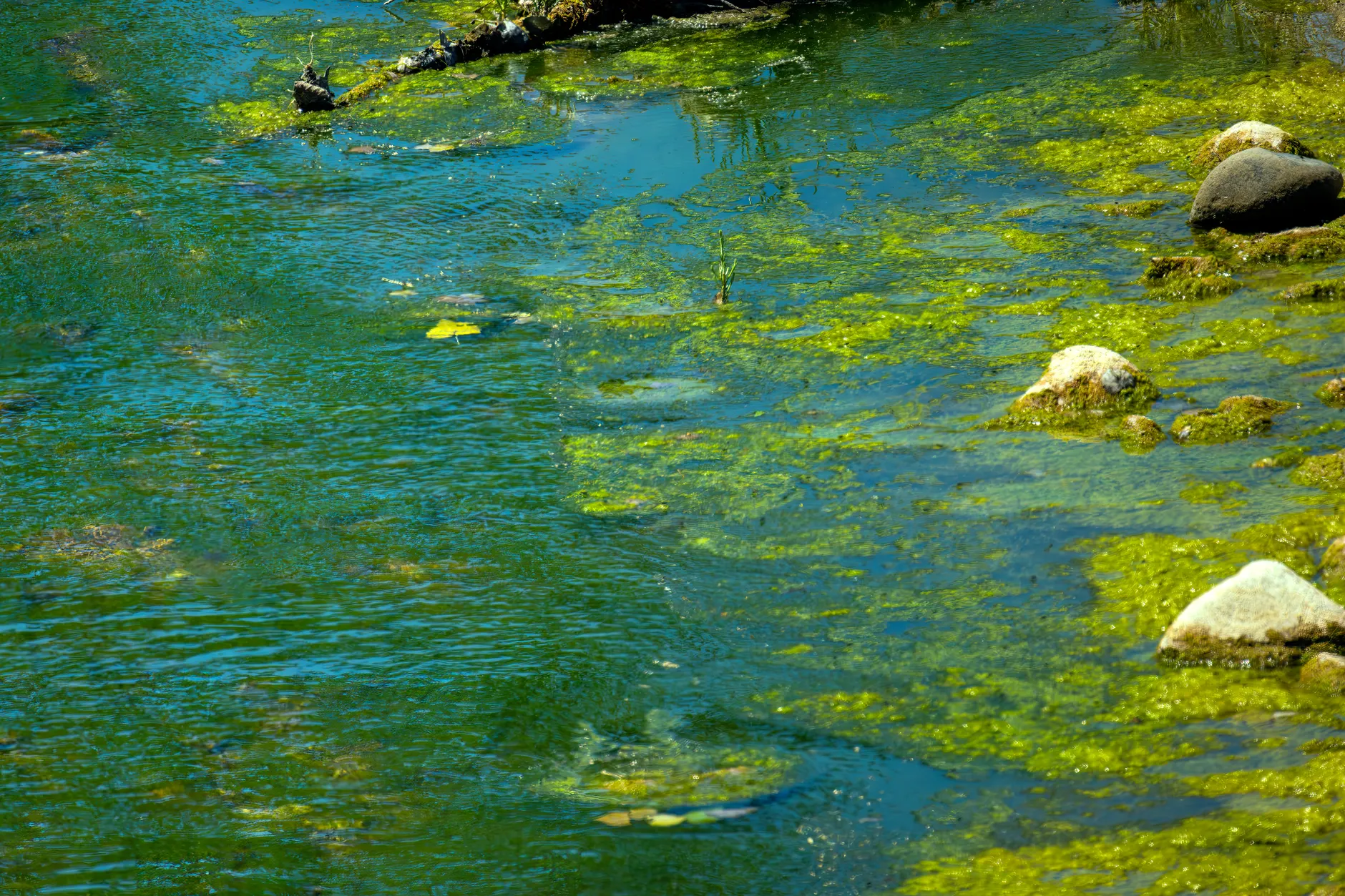
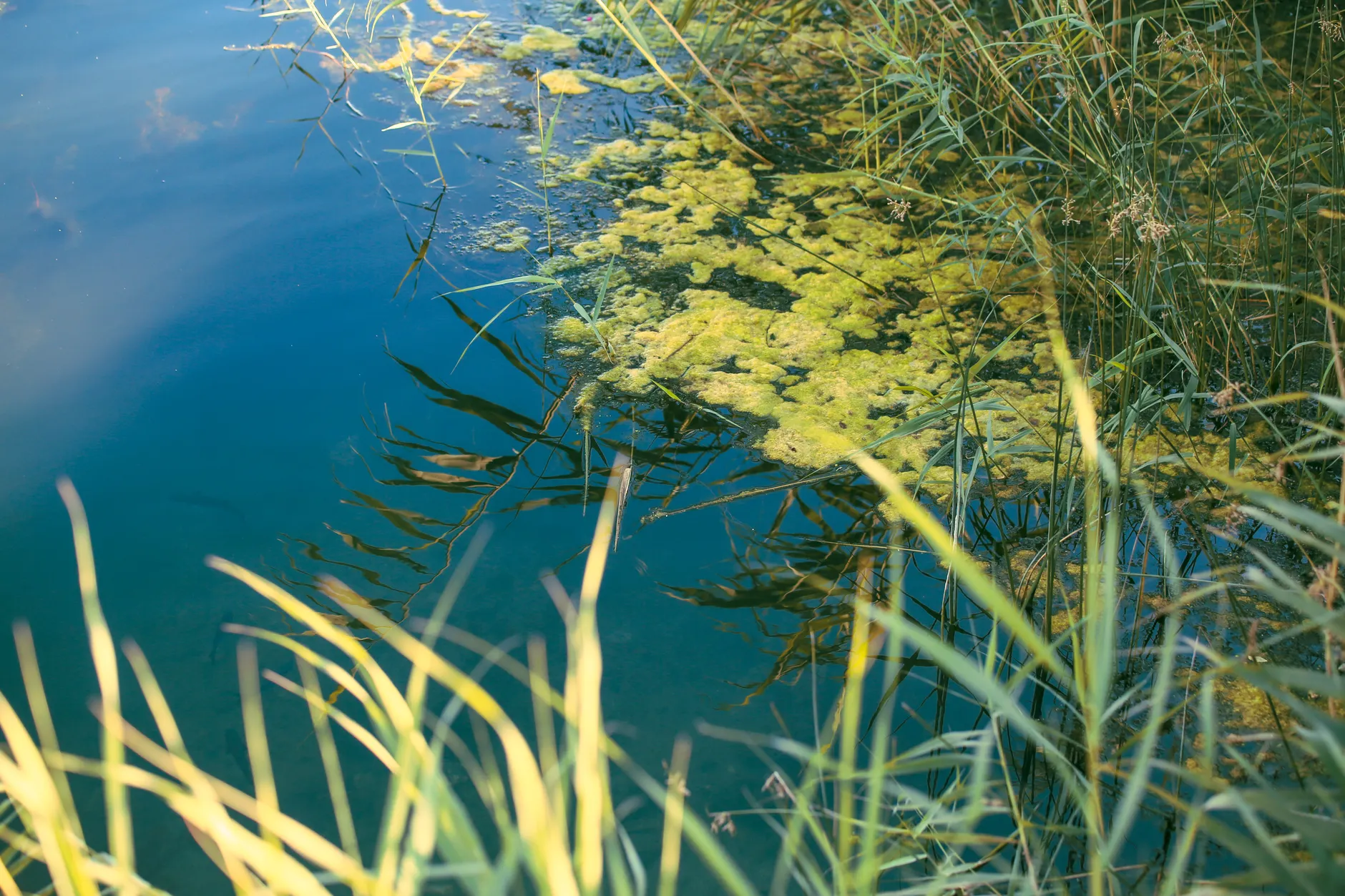
Look across the surface and along the shoreline before approaching the water. Wind can concentrate floating material against one bank, while sheltered coves can collect dense scum. Do not enter the water or handle the material to investigate it.
- Paint-like streaks or slicks: material that resembles spilled paint, sometimes gathered into swirls or bands.
- Pea-soup water: unusually dense, coloured water rather than a distinct surface layer.
- Floating flecks: particles resembling grass clippings or small clumps suspended in the water.
- Mats, scum or foam: accumulations at the edge, around vegetation or in sheltered corners.
- Unexpected colours: green, blue-green and turquoise are possible, but so are yellow, brown, red and white.
A musty, earthy or septic-like smell can accompany a bloom. No smell does not mean no toxin. Some blooms have little or no noticeable odour, and material dispersed below the surface may be difficult to see.
Can you distinguish it from ordinary algae or pollen?
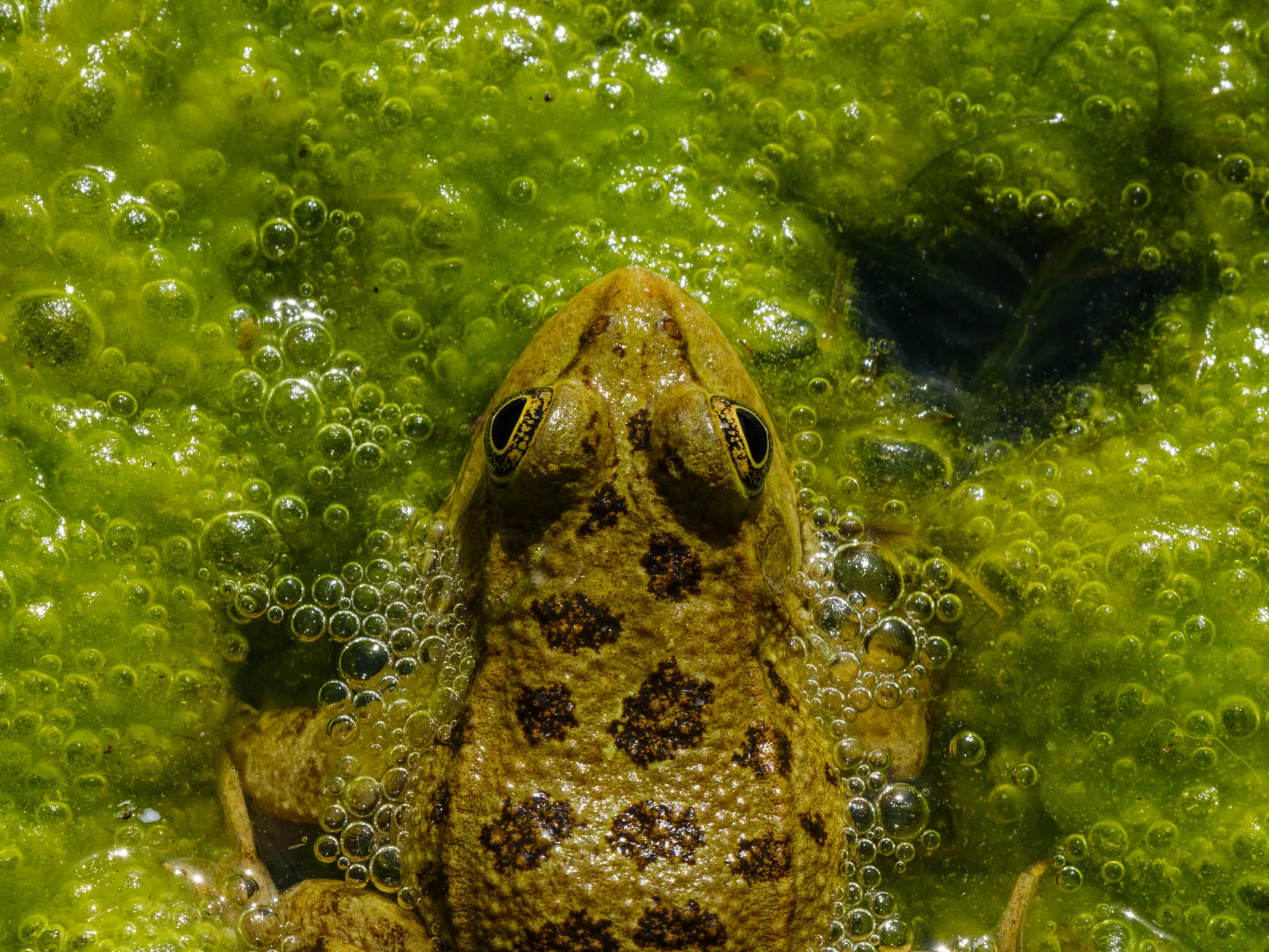
Duckweed, pollen, sediment and other algae can resemble a cyanobacterial bloom. These visual clues explain the overlap; they are not a swimming-clearance test.
| What you see | What it might be | What it cannot tell you |
|---|---|---|
| Many small, separate floating green leaves | Duckweed | Whether cyanobacteria are also present beneath or beside it |
| A yellowish, dusty surface film | Pollen, particularly in sheltered margins | Whether the film is harmless without reliable identification |
| Stringy or hair-like green growth | Filamentous green algae | Whether all material in the mat is the same organism |
| Brown or cloudy water after rain | Suspended sediment | Whether a separate cyanobacterial hazard is present |
| A paint-like slick, pea-soup appearance or dense coloured scum | A possible cyanobacterial bloom | Which toxins are present or their concentration |
Reliable identification and toxin measurement require appropriate field or laboratory testing. If you cannot explain unusual scum, mats, foam or discolouration, stay out and report it to the responsible authority. Do not use touching, stirring or smelling the material as a home test.
When not to swim, paddle or wade
- There is an official warning. Follow “do not swim”, “avoid contact”, harmful-algal-bloom and closure notices. Where notices differ, follow the most restrictive applicable instruction.
- You can see a suspected bloom. Stay out even if an online alert has not yet appeared. Authorities may not have inspected or sampled the location.
- A recent warning has no published cancellation or reopening notice. A missing sign or clearer shoreline does not cancel it.
- There are dead fish or unusually distressed wildlife. These can accompany harmful blooms, although their absence does not rule one out.
Avoid activities that put you in contact with affected water or spray. Wading is not a safe compromise, and moving a short distance along the same shore does not establish that you have left the affected area.
Do not drink bloom-affected water or use it for cooking, brushing teeth, making ice, washing food or filling a paddling pool. Boiling does not reliably remove cyanotoxins and can concentrate some of them. Advice about treated drinking-water supplies is separate from advice about swimming water.
Where to find official blue-green algae alerts
Check the exact water body on the day you plan to swim, then read signs at the entrance and water’s edge. A regional update, an old swimming guide or a social-media photograph does not establish the current status of a particular lake, river or cove.
| Location | Official places to check | Important limit |
|---|---|---|
| England | Environment Agency blue-green algae information; the relevant council, park authority, landowner or water company | Designated bathing-water results do not mean every inland swimming location is routinely tested for cyanobacteria. |
| Wales | Natural Resources Wales blue-green algae information; local authorities and site operators | Check the individual site’s warning or closure notice, not only a wider-area update. |
| Scotland | Scottish Environment Protection Agency environmental information; councils, landowners and site operators | Location-specific access restrictions and warning signs still apply. |
| Northern Ireland | Department of Agriculture, Environment and Rural Affairs; Northern Ireland Environment Agency; councils and site operators | Check the named water body and any local contact restrictions. |
| United States | State or tribal health and environmental agencies, county health departments, park agencies and lake managers | Responsibility varies by location; there is no single nationwide inland-lake clearance system. |
| US coastal and Great Lakes beaches | EPA’s Beach Advisory and Closing On-line Notification system, known as BEACON 2.0, alongside local beach notices | BEACON does not cover every inland lake or river. |
In US national parks, also check the individual National Park Service park’s alerts and safety notices. An open park does not necessarily mean every swimming area is open or monitored.
For a useful site check, note the issuing authority, notice date, affected area, latest sample date and the date you checked. Distinguish an advisory from a closure, and read what activities each notice restricts.
This guide does not provide live site statuses or current water-quality results. Where a location has no official routine cyanobacteria testing, treat it as unmonitored — not tested and clear. A pin on a map is not permission to swim; legal access and swimming permission need a separate check.
Why a good bathing-water rating is not enough
Routine bathing-water classifications and cyanobacterial toxin results measure different hazards. A favourable bacterial water-quality rating does not establish that a lake is free of cyanobacteria or their toxins.
Even a cyanotoxin result represents a particular sampling place and time. Wind, mixing and changing bloom growth can alter conditions elsewhere or after sampling. Check what was tested, where the sample was taken and its date — not just whether a result is labelled acceptable.
The US Environmental Protection Agency published recommended recreational cyanotoxin criteria in 2019, and the World Health Organization’s recreational-water guidelines were published in 2021. These support authority-led risk management; they are not a universal pass-or-fail test for swimmers. Follow the current local advisory rather than trying to overrule it with a result from another jurisdiction.
Why children and dogs need extra protection
Children are more likely to swallow water while playing and can take in a larger dose relative to their body weight. Shoreline play also puts them close to concentrated scum. Keep them away from suspected bloom material rather than allowing a shallow paddle. There is no universal safe splash distance from a bloom.
Dogs can drink affected water, swallow mats and lick contamination from their coats after leaving the water. Poisoning can cause vomiting, diarrhoea, drooling, weakness, stumbling, tremors, seizures, breathing problems, liver failure and death.
- Keep dogs on a lead near a suspected bloom and away from shoreline mats, foam, dead fish and affected puddles.
- Bring clean drinking water and a bowl. Do not rely on a clear-looking lake or river as a drinking source.
- If a dog enters suspected bloom water, prevent licking and rinse its coat and paws promptly with clean tap water.
- Contact a vet urgently if poisoning is suspected or any illness develops. Tell the vet about the possible cyanobacteria exposure.
What to do after possible exposure
Exposure can occur through swallowing water, breathing in droplets, or contact with skin and eyes. Symptoms can include rash, itching, eye or throat irritation, nausea, vomiting, stomach pain and diarrhoea. Some toxins can cause more serious liver or neurological effects.
- Leave the water. Keep other people and animals away from the suspected bloom.
- Rinse with clean fresh water. Wash exposed skin and hair, remove contaminated clothing and wash it before reuse. Flush irritated eyes with clean water without rubbing them.
- Seek medical advice for symptoms or suspected ingestion. Contact a local poison centre, medical service or NHS 111 where available. Do not induce vomiting unless a medical professional instructs you to.
- Use emergency services for severe symptoms. Breathing difficulty, seizures, collapse, confusion or severe weakness require emergency care.
- Record and report the exposure. Note the water body, exact location, date, time, type of contact and symptoms. Photographs taken from dry land can help the environmental-health, public-health, park or water authority investigate.
When can you swim again?
There is no universal waiting period after a bloom. Toxin persistence varies with the organism, toxin and environmental conditions. Wind or rain can disperse visible scum without establishing that the water is suitable for swimming.
Where an official warning was issued, wait for the responsible authority’s published cancellation or reopening decision. Check that it covers the intended swimming area, then inspect the shoreline again on arrival. Fresh signs of a suspected bloom are a reason to stay out even after an earlier reopening.
Warm, sunny weather, slow-moving water and nutrients from runoff favour bloom development. These conditions help explain when to be particularly alert, but they are not a forecast: blooms can recur, move or become less visible, and rain alone does not make a site clear.
The swimming decision
Visible suspected bloom or official warning: stay out and keep children and dogs away. Clear-looking water alone is not clearance; check legal access, the latest dated official notice and any available cyanobacteria result.
Swimming outdoors is at your own risk. Check current notices and conditions before getting in, and do not swim if a suspected bloom is present.