Open, seasonal or book ahead: establish which applies before travelling, along with legal access, swimming rules and any entry or parking charge. A public footpath beside a river does not automatically give you permission to swim. A map pin is a starting point, not permission to enter the water.
The most useful nearby swim is not necessarily the closest blue patch on a map. It is somewhere you can reach lawfully, enter and leave without negotiating dangerous banks, and assess using current opening notices and water-quality information. Here is how to build that shortlist without mistaking popularity for permission.
Find nearby candidates, then check the actual access
Search around your town or postcode first. Straight-line distance can be misleading: a lake a mile away may have its permitted entrance on the opposite shore, while a slightly more distant venue may have straightforward parking and a short approach.
- Search by water type. In Google Maps or Apple Maps, look for open-water swimming, swimming lakes, river swimming, beaches or designated bathing waters near your town. A managed open-water lake can be a useful alternative when local river access is unclear. A lido is another outdoor option, but it is a managed pool rather than a wild swim.
- Check the exact water body and entrance. Use OS Maps to understand footpaths, terrain, car parks and the approach to the bank. OpenStreetMap can help identify facilities and paths, but neither a mapped path nor a swimming symbol establishes permission.
- Find the site’s current rules. Check the council, park, landowner or venue’s information for that named water body. Look for swimming permission, opening dates, temporary closures and booking requirements. Reservoir recreation rules need particular attention: permission to walk around a reservoir is not permission to swim in it.
- Keep only workable candidates. Record the legal entrance, parking arrangements, walking route, swimming status and water-quality source. If swimming rights or permission remain unclear, leave that location off the shortlist.
Local swimming groups can help identify names and explain how a permitted venue operates. Treat social posts, old blogs and map reviews as leads, not evidence of current access, opening or water quality.
Understand the different access rules across the UK
England and Wales: access to the bank is not a right to swim
There is no general right to swim in every river, lake or reservoir in England or Wales. A public right of way provides access along its route; it does not automatically let you cross adjoining private land or enter the water.
The Countryside and Rights of Way Act 2000 provides access on foot to mapped open-access land, but that statutory right does not generally include swimming. For private waters, look for explicit landowner permission or another applicable legal access arrangement. Natural Resources Wales advises checking local restrictions and landowner arrangements in Wales.
National park boundaries, National Trust ownership and a public car park do not settle the question. Check the rules for the particular lake, river section or pool, including its entry bank.
Scotland: responsible access includes most inland water
The Land Reform (Scotland) Act 2003 gives responsible access rights to most land and inland water, including swimming. Individual landowner permission is not generally required where those rights apply.
Those rights have limits. They do not extend to places such as private gardens, most school grounds and land close to houses where privacy is protected. Follow the Scottish Outdoor Access Code: avoid damage, disturbance to wildlife and interference with land management. Check for lawful temporary restrictions and use an approach that respects excluded land.
Northern Ireland: check access separately from bathing-water status
Do not apply Scotland’s access rules to Northern Ireland. Check the council, landowner or operator’s access arrangements for the particular location. A DAERA bathing-water classification does not give a general right to cross neighbouring land.
Read official water-quality information correctly
Designated bathing waters have official monitoring programmes. Many other rivers, lochs, tarns and waterfall pools used by swimmers do not. Legal access and official testing are separate questions: a Scottish loch can be lawfully accessible without having a routine bathing-water result.
| Nation | Official bathing-water authority | Information to check |
|---|---|---|
| England | Environment Agency | The named bathing-water profile, annual classification, published sample dates and any pollution-risk warning. |
| Wales | Natural Resources Wales | The named bathing-water profile, annual classification and current pollution or local-authority advice. |
| Scotland | Scottish Environment Protection Agency — SEPA | The named bathing-water record, annual classification and current advice or warnings. |
| Northern Ireland | Department of Agriculture, Environment and Rural Affairs — DAERA | The named bathing-water profile, annual classification and current bathing advice. |
In England and Wales, the official bathing season runs from 15 May to 30 September. Scotland’s routine bathing-water monitoring season generally runs from 1 June to 15 September. Outside the monitoring season, an absence of warnings is not evidence of recent sampling.
Keep the classification, sample date and warning separate
The annual categories are Excellent, Good, Sufficient and Poor. They summarise monitoring results over an assessment period, rather than conditions at the moment you arrive. In England, assessments measure Escherichia coli and intestinal enterococci, indicators of faecal pollution; they do not test for every possible hazard.
- Annual classification: record the category, authority and classification year. Do not describe an Excellent classification as a guarantee of safe water.
- Latest published sample: read its collection date. The date you open the page is not the date the water was sampled.
- Current warning: check the warning’s date and whether it remains active. A pollution warning matters even when the annual classification is Good or Excellent.
- No routine result: if the relevant regulator has no routine result for the location, record “No official routine water-quality result found.” Do not substitute a nearby beach’s result or another part of the river.
Clear water, an absence of smell and other people swimming cannot establish microbiological water quality. Conversely, visible sewage, unusual discolouration, dead fish or floating sanitary waste are reasons not to enter, regardless of an older test result.
Check today’s status, costs and restrictions
A useful swimming listing needs a dated status, not just the word “popular”. Use the following distinctions when checking your shortlist.
- Open: public access and lawful swimming are established, with no current closure identified. This does not imply lifeguards or suitable conditions.
- Seasonal: swimming is available only within stated dates or operating hours. Check the actual session, not just the month.
- Book ahead: entry requires a reservation. Confirm availability, admission price, induction requirements and whether membership is necessary.
- Closed or swimming banned: do not enter. A temporary pollution, algae or operational closure overrides an older recommendation.
At managed lakes, check minimum ages, tow-float and swim-cap rules, session length, changing facilities and rescue cover. A booking confirmation does not mean every part of the lake is open for swimming. At public beaches, free entry can still involve parking charges and seasonal facilities.
Keep the operator, council or regulator’s name alongside the date you last checked each detail. Record prices in pounds and distinguish admission from parking, membership and spectator charges. Recheck before setting off: an old opening notice cannot establish today’s status.
Match the location to the conditions
Only assess a location as a swimming candidate once lawful access is established. The next question is whether its particular hazards fit your experience and the day’s conditions.
- Rivers: check river levels, flood warnings and recent rainfall. Avoid weirs, fast flow, submerged obstacles and branches that can trap a swimmer. A familiar entry point may become unusable when levels rise.
- Lakes and tarns: check wind, boating areas, fishing restrictions and algae notices. Plan an exit that does not depend on climbing a steep or slippery bank.
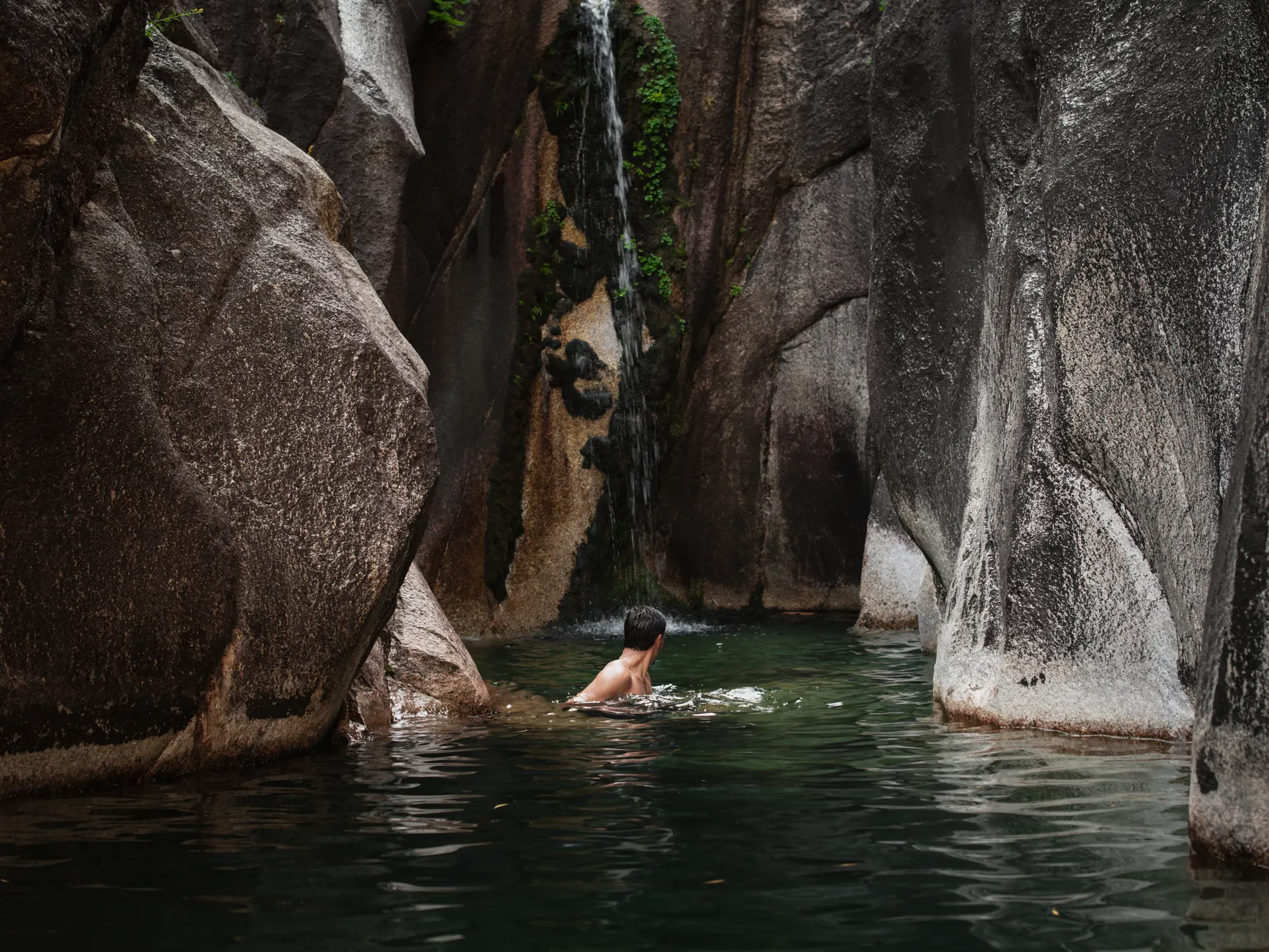
- Waterfall pools: swimming permission does not remove the hazards of falling rocks, submerged debris, recirculating currents or flash flooding. Do not use the plunge beneath falling water as an entry point.
- Sea and rock pools: check tides, swell, wind and wave overtopping. Identify an exit that will remain available as the tide changes.
- Reservoirs and quarries: do not infer permission from public access around the edge. Consider them only where the operator expressly permits swimming, and follow the designated area and session rules.
Heavy rainfall can increase both flow and contamination from farmland, roads and sewage systems. Consider rainfall over the preceding 24-72 hours, but do not treat that range as a universal waiting period: catchments and incidents differ. Follow current regulator, council and operator advice, and check relevant water-company incident notices alongside bathing-water information.
For lakes and slow-moving water, check blue-green algae warnings. Stay out where an authority has issued a warning or where scum or surface mats are visible. A lack of visible algae does not replace official advice.
Make the first visit easy to abandon
For an unfamiliar location, a staffed open-water session can provide a defined course, a briefing and clearer emergency arrangements. If choosing an unstaffed permitted spot, go with a companion and inspect the bank before changing. Arriving does not commit you to swimming.
- Locate the exit before entering. Check footing, depth, current and an alternative way out. Do not jump into unknown water or assume you can climb back up the entry bank.
- Prepare for cold water and communication. Have dry layers ready, tell someone your location and plan, and carry a protected means of calling for help. A bright cap and tow float improve visibility; a tow float is not a buoyancy aid.
- Enter gradually. Sudden immersion can cause involuntary gasping and rapid breathing. Follow RNLI advice to enter slowly, avoid alcohol and keep breathing controlled. Do not copy another swimmer’s distance or duration.
- Leave while the exit remains straightforward. Dry and dress promptly; cooling can continue after leaving the water. Avoid swallowing water, cover cuts and wash afterwards to reduce exposure to waterborne infection.
Save the nearest road, named landmark and access gate as well as a grid reference or location pin. Mobile reception may be absent beside cliffs, in valleys or around remote lochs. In an emergency call 999; at the coast, ask for the Coastguard.
When a promising map result fails the checks
- The map says swimming, but the site says no: follow the current site restriction. Do not look for an unofficial entrance.
- A path reaches the bank, but swimming permission is unclear: establish the applicable access right or contact the responsible landowner or operator. In England and Wales, the footpath alone does not answer the swimming question.
- The annual classification is Excellent, but a warning is active: follow the current warning. Revisit the choice after the authority updates its advice.
- There is no official routine testing: recognise the information gap. If dated regulator results are important to your decision, choose a designated bathing water instead.
- The permitted entrance or car park is inaccessible: use another lawful, documented approach or another venue. Do not block passing places, farm entrances or emergency access.
Keep a shortlist you can actually use
Save the exact place name, lawful entrance, status and last-checked date, fees, booking details, and the official water-quality record with its own dates. If a Wild Swim Atlas listing no longer matches an operator’s notice, report the change so the entry can be reviewed.
Outdoor swimming is at your own risk. Check access, opening notices, water-quality advice, weather, flow or tides, and your exit before every swim.